
What's Your Real Shopify Cost Per Order? (Most Stores Guess Wrong)
Most Shopify merchants know their product cost. Some know their shipping cost. But ask them what it actually costs to fulfill and deliver a single order — the full, honest number — and you'll get a pause, a rough estimate, or a number that's missing at least two line items.
That gap between "what I think it costs" and "what it actually costs" is where profit disappears. And when you're making decisions about pricing, ad spend, or discounts based on a wrong cost per order, every one of those decisions is built on sand.
This article breaks down every cost that goes into a real Shopify cost per order, shows you how to calculate it properly, and explains why getting this number right is one of the highest-leverage things you can do for your store's profitability.
What is cost per order?
Cost per order is the total amount it costs you to receive, process, and fulfill a single customer order — including product costs, transaction fees, shipping, packaging, platform costs, and marketing spend.
It's not just your product cost. It's every dollar that leaves your pocket from the moment someone places an order to the moment it arrives at their door (and sometimes beyond, if they return it).
Why most stores get this wrong
Here's the honest reason: Shopify doesn't show you this number. Your Shopify dashboard shows revenue, order count, and some high-level summaries. It does not calculate your true cost per order.
So most merchants build a mental model. They think: "My product costs $12, shipping is about $6, so I'm spending around $18 per order." Then they price at $45 and think they're making $27 per unit.
But that mental model leaves out:
- Shopify subscription cost allocated per order
- Transaction and payment processing fees
- Packaging and inserts
- Customer acquisition cost (the ad spend that generated the order)
- Returns and refunds
- Apps and tools allocated per order
Once you add those in, that "$27 margin" often looks very different.
We've seen stores doing $50,000/month in revenue that were genuinely surprised to find their real cost per order was $8–$12 higher than their estimate. At 500 orders a month, that's $4,000–$6,000 in profit they weren't accounting for.
The real components of Shopify cost per order
Let's build this from the ground up. Here's every cost category you need to include.
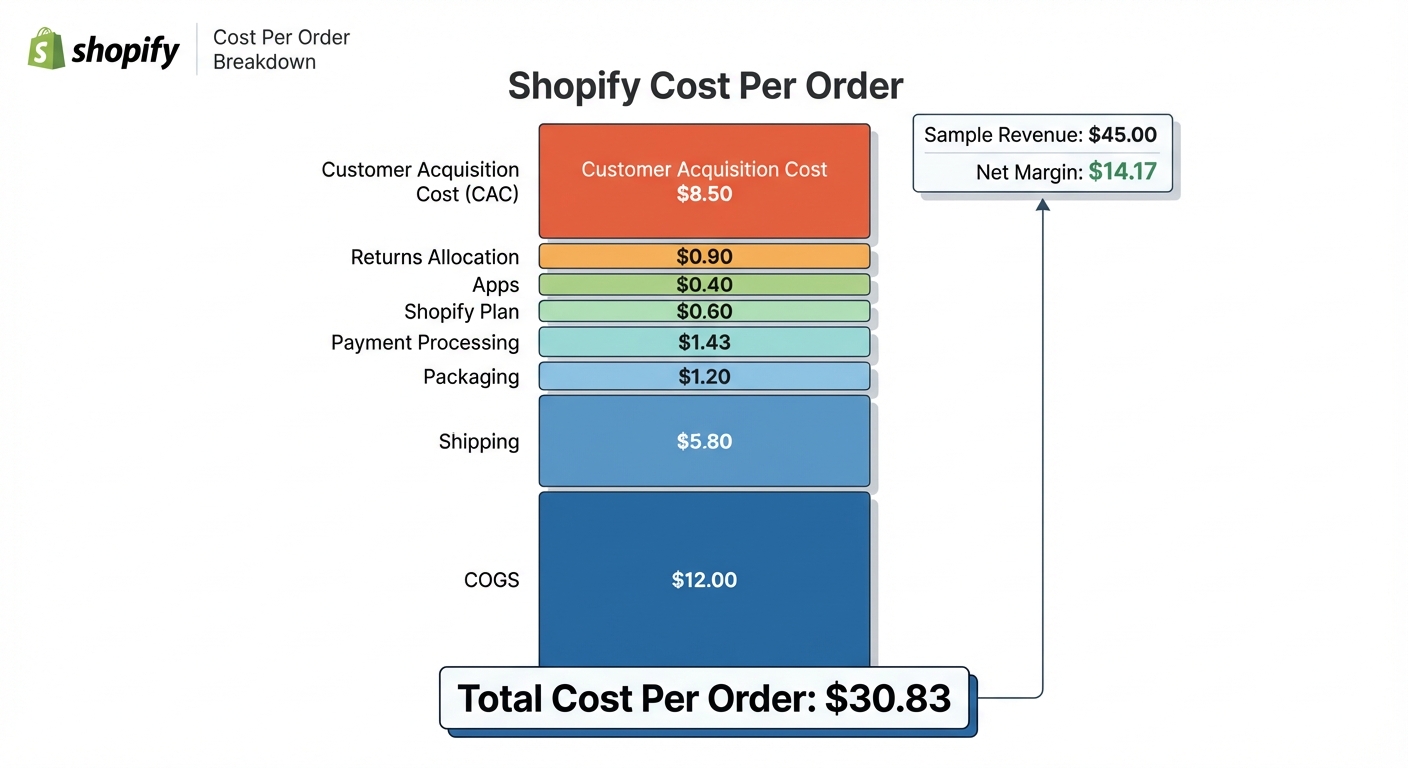
Cost of goods sold (COGS)
This is your product cost — what you paid your supplier or manufacturer per unit. If you're dropshipping, it's your supplier price. If you hold inventory, it includes landed cost: what you paid plus freight, customs, and any storage fees.
A lot of merchants use just the invoice price and skip the freight and storage. That's a mistake. If you import 1,000 units and pay $800 in freight, that's $0.80 per unit that has to be in your cost of goods sold (COGS).
Shipping costs
If you charge customers for shipping, you still need to include your actual carrier cost in the cost per order — not the customer's contribution, but the actual outgoing cost. If you offer free shipping, the full carrier rate is on you.
At typical USPS, UPS, or FedEx rates for small parcels, this often runs $5–$8 for domestic US shipments. If you're shipping heavier items or using two-day delivery, it can be $12–$20+.
Packaging and inserts
Boxes, poly mailers, tissue paper, tape, branded inserts, thank-you cards — these add up faster than most merchants expect. A decent unboxing experience might cost $1.50–$3.00 per order in materials. If you're buying in bulk, it's lower. But it's never zero, and it needs to be counted.
Payment processing fees
If you use Shopify Payments in the US, your processing fee is 2.9% + $0.30 per transaction on the Basic plan, 2.6% + $0.10 on Shopify plan, and 2.4% + $0.10 on Advanced. On a $45 order using Basic, that's $1.61.
If you use a third-party payment processor, Shopify also charges an additional transaction fee of 2%, 1%, or 0.5% depending on your plan. That's on top of whatever your processor charges. It adds up surprisingly fast.
Learn more about Shopify Payments fees on Shopify's official pricing page.
Shopify subscription allocated per order
Your Shopify plan costs $29–$299/month (Basic through Advanced). That's a fixed cost, but it belongs in your cost per order calculation.
Here's how to think about it: if you're on the $79/month Shopify plan and fulfill 200 orders/month, that's $0.40 per order. At 50 orders/month, it's $1.58 per order. The lower your volume, the more each order carries of that fixed overhead.
App subscriptions allocated per order
Email marketing, review apps, upsell tools, loyalty programs, subscription management — most Shopify stores run $100–$400/month in app costs. Divide that by your monthly order count and you get the per-order allocation. At $200/month in apps and 200 orders, that's $1.00 per order in app overhead.
It doesn't sound like much. But it's real money, and it belongs in the calculation.
Customer acquisition cost (CAC)
This is the one that trips up the most stores. If you're running paid ads — Facebook, Instagram, Google, TikTok — your advertising spend is a direct cost of generating orders.
If you spent $2,000 on Facebook ads last month and it generated 200 orders, your customer acquisition cost is $10 per order. That $10 has to be included in your cost per order, full stop.
Many merchants track ROAS (return on ad spend) and feel good about a 3x or 4x return. But ROAS alone doesn't tell you if the order was profitable after all the other costs. A $45 order with 3x ROAS means $15 in ad spend per order — which is already more than the $10 example above. Stack that on top of a $12 COGS, $6 shipping, and $2 in fees, and your profit on that $45 order might be $10 or less.
Returns and refund allocation
If your return rate is 5% and your average order value is $45, your per-order return cost includes both the refund probability and the cost of processing the return (return shipping label, restocking, potential product loss).
A straightforward way to estimate this: if 5% of orders result in a full refund plus a $4 return label, that's (0.05 × $45) + (0.05 × $4) = $2.25 + $0.20 = $2.45 per order in expected return cost.
Want to see your real numbers?
Try our free profit calculator — plug in your numbers and see your real net margin in 30 seconds.
Try the free calculator →Worked example: what a real cost per order looks like
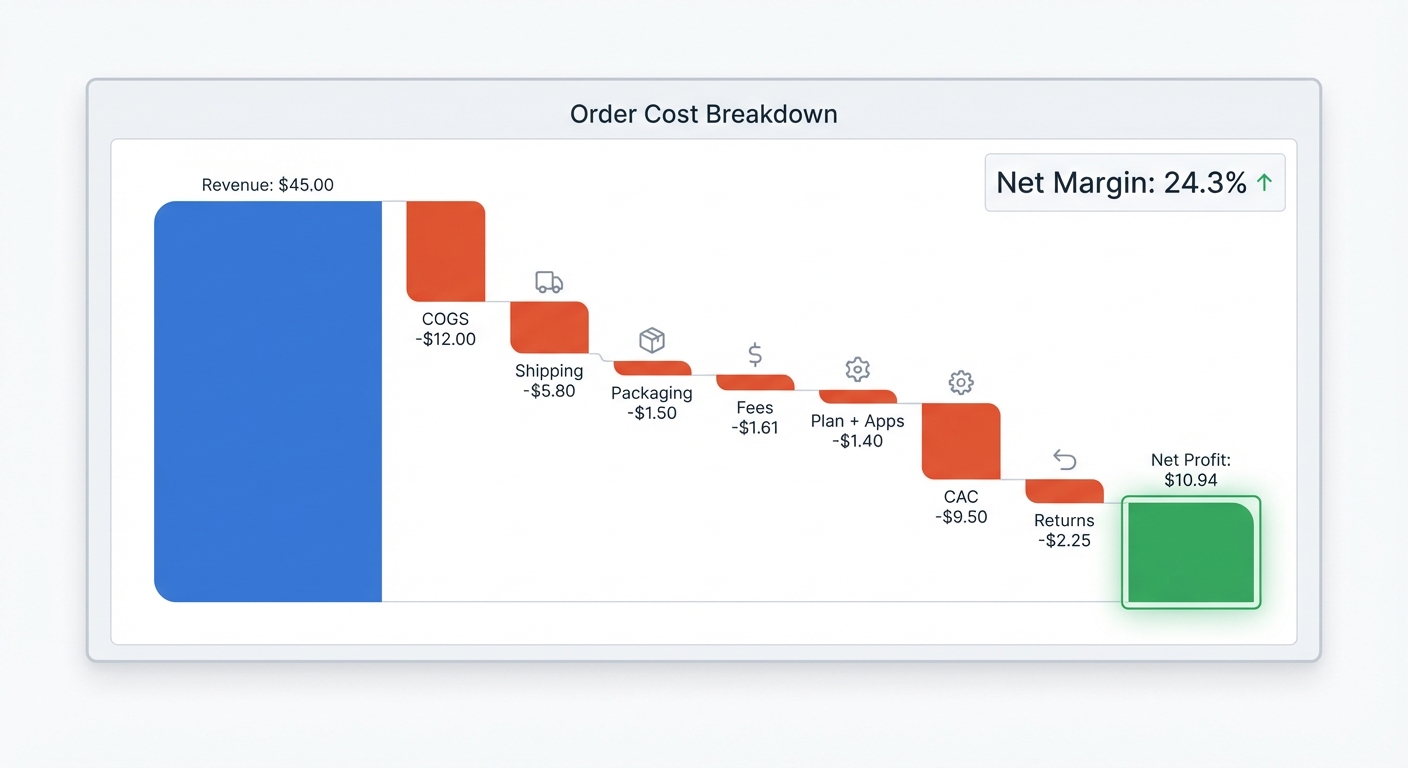
Let's put it all together for a hypothetical home goods store — realistic numbers, nothing cherry-picked.
| Cost Component | Per Order |
|---|---|
| COGS (product + freight) | $12.00 |
| Outbound shipping | $5.80 |
| Packaging and inserts | $1.50 |
| Shopify Payments (Basic, $45 order) | $1.61 |
| Shopify plan allocation (200 orders) | $0.40 |
| App subscriptions allocation | $1.00 |
| Customer acquisition cost | $9.50 |
| Returns allocation (5% return rate) | $2.25 |
| Total cost per order | $34.06 |
Average order value: $45.00
Net margin per order: $10.94 (24.3%)
Now remove the CAC and returns allocation — which many merchants do, because they're not tracking them per order — and the apparent "cost" looks like $22.31, leaving an apparent "profit" of $22.69 per order. That's more than double what they're actually making.
That's the difference between thinking you have a 50% margin and actually having a 24% margin. Both stores sell the same product at the same price. Only one of them knows what's real.
How to calculate your Shopify cost per order
Here's a straightforward process to get to your real number.
Step 1: Find your average COGS per order
Pull your total product cost for the month (including inbound freight) and divide by your order count. If you sell multiple products, weight the calculation by sales volume.
Step 2: Calculate your average outbound shipping cost
Look at your shipping carrier invoices for the month, not what customers paid — what you paid. Divide by orders shipped.
Step 3: Estimate packaging cost per order
Add up your monthly packaging supply spend and divide by order count.
Step 4: Calculate payment processing fees per order
Take your total processing fees for the month (visible in Shopify Payments payouts or your payment processor dashboard) and divide by orders.
Step 5: Allocate fixed platform costs per order
Add your monthly Shopify plan cost + app subscriptions, then divide by monthly order count.
Step 6: Calculate your customer acquisition cost
Divide total ad spend for the month by the number of orders attributable to paid channels. If you don't have solid attribution data, use a blended approach: total ad spend ÷ total orders.
Step 7: Add returns allocation
Multiply your return rate by your average order value and add a per-return processing cost estimate. Add these together and multiply by your return rate.
Step 8: Sum everything up
Add all seven components. That's your true Shopify cost per order.
When you do this properly, it usually takes 30–45 minutes the first time and 10 minutes every month after that once you have a template.
How often should you recalculate?
Monthly, at minimum. Your costs shift — shipping rates change, your ad costs fluctuate seasonally, Shopify plan costs change if you upgrade. A cost-per-order calculation from six months ago is not a reliable guide for today's pricing decisions.
If you're scaling aggressively or running frequent promotions, recalculate every two weeks. A promo that looked profitable when your CAC was $8 might be losing money when your CAC jumps to $14 in Q4.
What to do with this number
Once you have your real cost per order, a few things become clearer immediately.
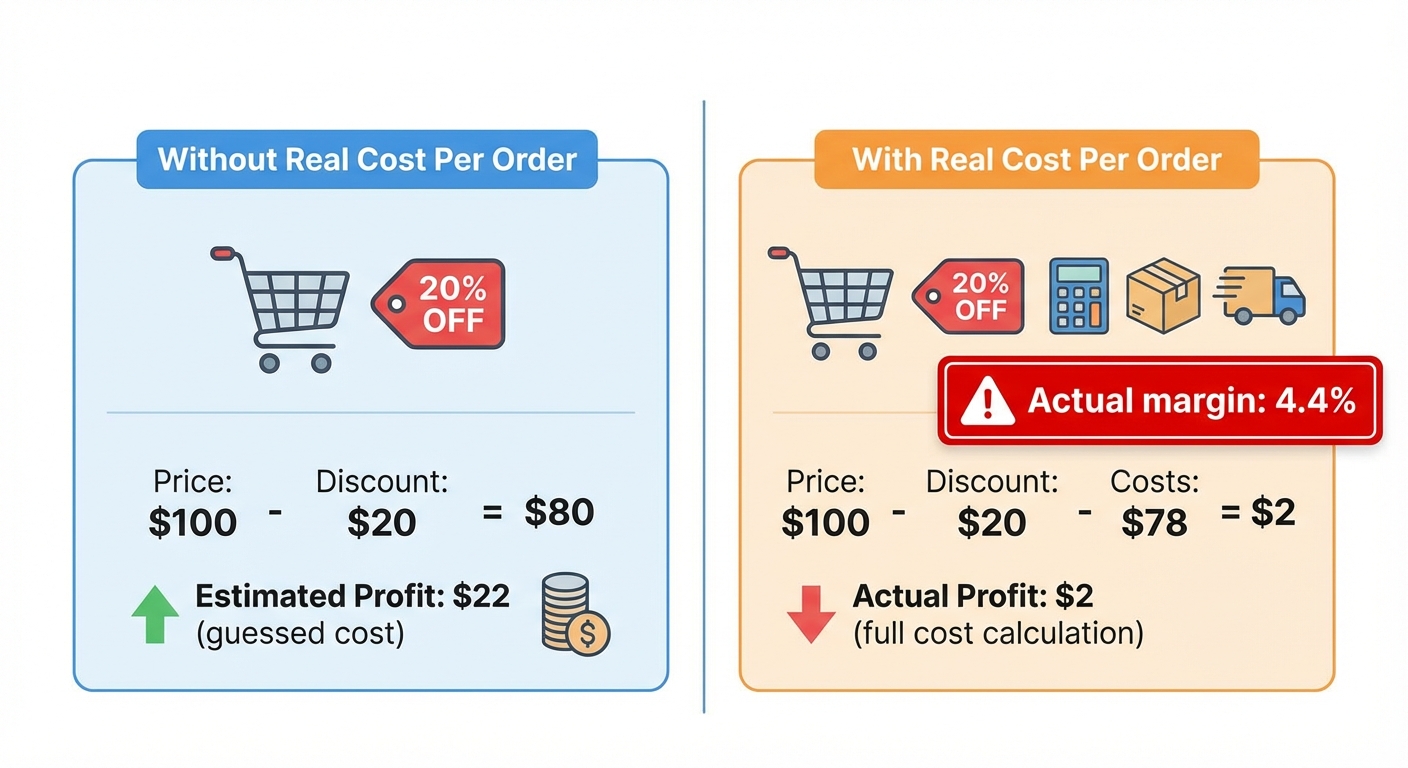
Pricing decisions: If your real cost per order is $34 and you're selling at $45, a 20% discount code brings your revenue to $36 — and you're making $2 per order before anything goes wrong. That's almost no room for error.
Ad spend decisions: You now know the maximum you can afford to pay for a customer. If your cost per order excluding CAC is $24.56 and you sell at $45, your maximum CAC is $20.44 before you break even. You can make this a hard cap in your ad accounts.
Free shipping thresholds: If your average shipping cost is $5.80, your free shipping threshold needs to be set so that the additional margin on orders above the threshold covers the shipping cost. Knowing your cost per order makes this math direct.
Wholesale and bulk pricing: If a wholesale buyer wants 40% off your retail price, you need to know your cost per order to know if that offer makes any sense.
The manual approach vs. having it done for you
Everything above is doable manually. It requires pulling data from Shopify, your carrier accounts, your ad platforms, and your payment processor, combining it in a spreadsheet, and maintaining that spreadsheet every month.
A lot of merchants start that way. And then they let the spreadsheet go stale because it takes too long or because the data lives in five different places.
The alternative is using a tool that pulls all of that together automatically. Shopimize connects to your Shopify store and pulls in your COGS, Shopify fees, shipping costs, and ad spend to calculate your real profitability — including a true cost per order — without the monthly manual process.
The goal isn't to replace the understanding you build from doing the calculation yourself. It's to make sure you're always looking at current, accurate numbers when you're making decisions — not a spreadsheet that was last updated six weeks ago.
Your real Shopify cost per order is almost always higher than you think
If there's one thing this article should leave you with: the number you have in your head right now is probably too low. Not because you're being careless, but because Shopify's native reporting doesn't surface the full picture, and because some of these costs — like CAC and returns allocation — don't show up in obvious places.
The merchants who build sustainable, profitable Shopify stores are the ones who know their real Shopify cost per order and price, spend, and discount accordingly. Everyone else is guessing — sometimes successfully, sometimes not, and rarely knowing the difference until it's a problem.
Start seeing your real numbers
If you're ready to stop estimating and start knowing, Shopimize is built specifically for Shopify merchants who want their real profit picture — cost per order, net margin by product, and the full breakdown of what's actually eating into your revenue.
[Try Shopimize free and see your true cost per order in minutes.]
Frequently asked questions
What is a good cost per order for a Shopify store?
There's no universal benchmark — it depends entirely on your average order value, product type, and business model. What matters is that your cost per order (including COGS, shipping, fees, and customer acquisition cost) is low enough to leave a net margin that makes your business sustainable. Most healthy e-commerce businesses target a net margin between 15% and 30% after all costs.
Does Shopify show cost per order anywhere in the dashboard?
Not in a meaningful way. Shopify's built-in analytics show revenue and order counts, and some plan-level reports include basic sales data. But Shopify does not calculate a true cost per order that includes payment processing fees, allocated platform costs, customer acquisition cost, and returns. You need to calculate this yourself or use a third-party profit analytics tool.
How does customer acquisition cost affect cost per order?
Customer acquisition cost (CAC) is the ad spend or marketing cost attributable to generating a specific order. If you spent $1,000 on ads and got 100 orders, your CAC is $10 per order. That $10 is a direct cost of fulfilling those orders and must be included in your cost per order calculation. Many merchants track ROAS without converting it to a per-order cost, which leads them to overestimate how profitable their ad campaigns actually are.
What's the difference between cost per order and cost per acquisition?
Cost per order and cost per acquisition (CPA) are related but not the same. CPA typically refers only to the marketing cost to acquire a customer — your ad spend divided by conversions. Cost per order is a broader metric that includes CPA plus all fulfillment costs: COGS, shipping, packaging, payment fees, and platform overhead. Cost per order is the more complete number for understanding true profitability.