
Revenue vs Profit: Why Growing Sales Can Shrink Your Take-Home
You just hit a revenue milestone. Maybe it's $50k in monthly sales, or $100k—doesn't matter. You celebrated. Your team celebrated. You probably posted about it on social media.
Then you looked at your bank account.
It wasn't as full as you expected.
This is the brutal reality facing thousands of e-commerce sellers right now: revenue and profit aren't the same thing. Not even close. You can grow revenue while shrinking profit. It happens every single day, and most store owners don't realize it's happening until the damage is done.
Here's what we're going to cover: why this happens, how it actually works mathematically, and most importantly—how to grow revenue and profit at the same time.
[IMAGE PLACEHOLDER: A graph showing revenue increasing while profit decreases]
The Revenue vs Profit Paradox
Let's start with the basics, because this matters.
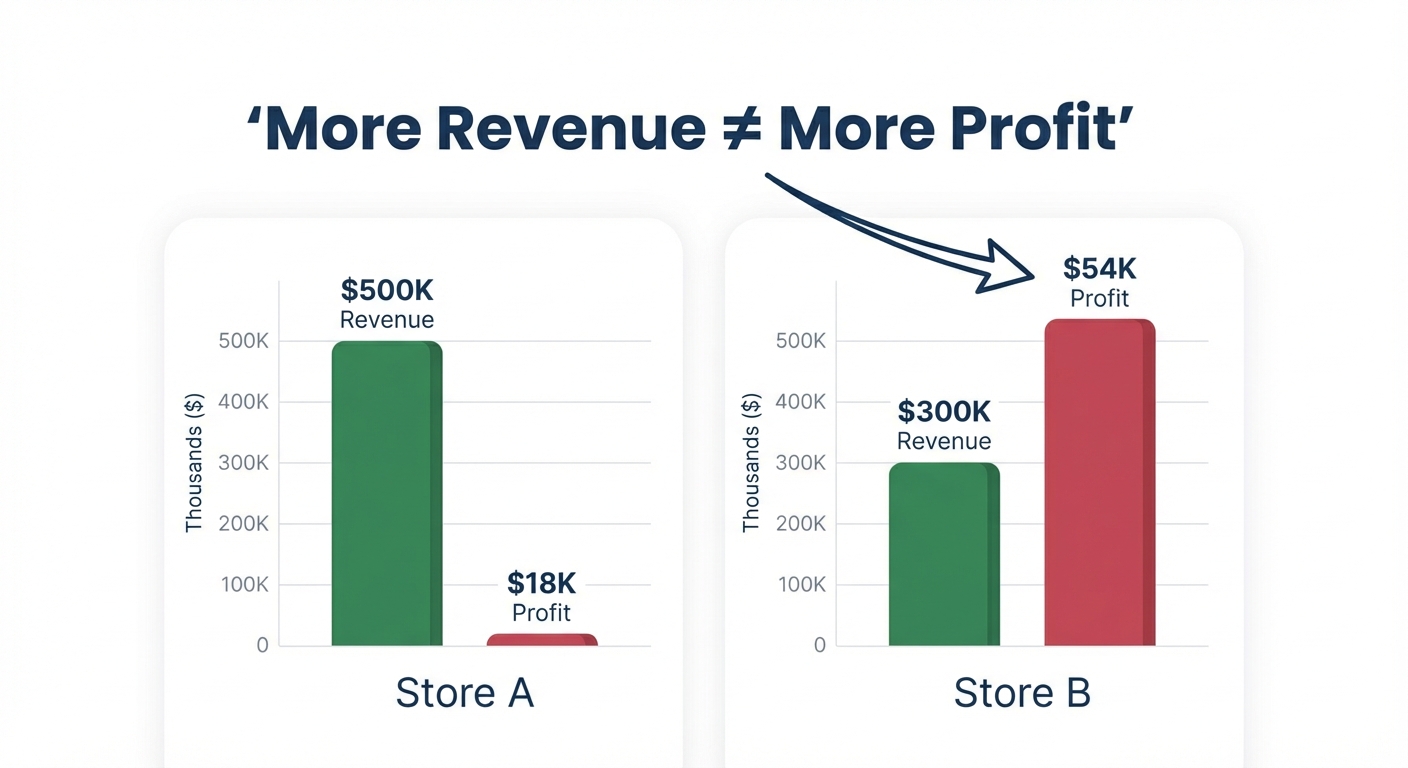
Revenue is the total money coming in from sales. If you sell 100 units at $50 each, you have $5,000 in revenue. Simple.
Profit is what's left after you pay for everything—inventory, shipping, ads, payment processing, returns, salaries, rent. Everything. It's the money you actually get to keep.
The gap between those two numbers? That's where most e-commerce owners get confused.
Many sellers operate under a dangerous assumption: "If my revenue is growing, my profit is growing." It's not true. You can have growing revenue with flat or declining profit. In fact, aggressive revenue growth strategies often compress your margins without you even realizing it.
Let's look at why.
Scenario 1: The Discount Trap
You're running a $40k/month e-commerce store. Your average order value is $60, your product cost is $20, and you're profitable at about 25% net margin. Things are stable. Boring, even.
Then you decide to run a sale.
You offer 25% off everything. Your logic: lower prices mean more volume. And you're right. Your orders double. Awesome, right?
Let's do the math.
| Metric | Q1 (Before Sale) | Q2 (During Sale) | Change |
|---|---|---|---|
| Total Orders | 667 | 1,334 | +100% |
| Avg Order Value | $60 | $45 | -25% |
| Revenue | $40,000 | $60,030 | +40% |
| Product Cost | $13,340 | $26,680 | +100% |
| Shipping Cost | $2,668 | $5,336 | +100% |
| Payment Processing (3%) | $1,200 | $1,801 | +50% |
| Advertising | $6,000 | $8,500 | +42% |
| Profit | $16,792 | $17,713 | +5% |
Wait, that looks okay. But let's look deeper.
What if your discount brought in less quality traffic? What if you ran heavier ads to drive that volume? Now the numbers look different:
| Metric | Q1 (Before Sale) | Q2 (Aggressive Discount) | Change |
|---|---|---|---|
| Total Orders | 667 | 1,334 | +100% |
| Avg Order Value | $60 | $45 | -25% |
| Revenue | $40,000 | $60,030 | +40% |
| Product Cost | $13,340 | $26,680 | +100% |
| Shipping Cost | $2,668 | $5,336 | +100% |
| Payment Processing (3%) | $1,200 | $1,801 | +50% |
| Advertising | $6,000 | $12,000 | +100% |
| Profit | $16,792 | $14,213 | -15% |
There it is. Revenue up 40%. Profit down 15%. You're busier. You're shipping more. Your team's working harder. But you're actually making less money.
This is the discount trap. It's seductive because revenue grows. But unless that growth comes with disciplined unit economics, you're just moving inventory at lower margins while increasing operational stress.
Scenario 2: The Ad Spend Spiral
This one's sneakier.
You've got a clean e-commerce store doing $30k/month with a customer acquisition cost (CPA) of $12. Your average order value is $65. Your gross margin is 55%. Everything makes sense.
You decide to scale. You increase your Facebook ad budget by 50%. More spend, more reach, more orders, right?
The first week is great. Orders spike. Then the second week comes.
Facebook's algorithm is showing your ads to increasingly cold audiences. Your CPA climbs to $14, then $16, then $18. By week four, you're paying $22 per customer acquisition.
Let's see what happened to profit:
| Metric | Month 1 (Before Scale) | Month 2 (After Scale) | Change |
|---|---|---|---|
| Revenue | $30,000 | $48,000 | +60% |
| Orders | 461 | 738 | +60% |
| Cost of Goods Sold | $13,500 | $21,600 | +60% |
| Gross Profit | $16,500 | $26,400 | +60% |
| Advertising Spend (CPA: $12 → $22) | $5,532 | $16,236 | +193% |
| Other Operating Costs | $4,968 | $4,968 | — |
| Net Profit | $6,000 | $5,196 | -13% |
Your revenue went up 60%. Your advertising spend nearly tripled. And your profit actually declined.
This happens because of diminishing returns in paid advertising. The cheap customers are acquired first. Scaling means paying more for each additional customer until you hit the point where revenue growth doesn't cover your acquisition costs anymore.
Many sellers don't notice this until they've been bleeding money for weeks. By then, they've already committed to higher ad spend, higher inventory, and higher operational costs.
Want to see your real numbers?
Try our free profit calculator — plug in your numbers and see your real net margin in 30 seconds.
Try the free calculator →Scenario 3: The Free Shipping Threshold
You've read the data. Free shipping converts better. So you decide: offer free shipping on orders over $40.
Your average order value was $55. Your shipping cost per order was $4. Your net margin was healthy.
What happens? AOV climbs to $68. Awesome. Conversion rate improves. More customers hit that $40 threshold, so you ship more orders for free.
But here's the catch: free shipping is literally you paying the shipping cost. And when you're subsidizing it, the cost per shipment doesn't actually drop. It stays around $4 per order, or worse, climbs to $5-$9 if you're absorbing dimensional weight charges from carriers.
| Metric | Before Free Shipping | After Free Shipping | Change |
|---|---|---|---|
| Average Order Value | $55 | $68 | +24% |
| Monthly Orders | 500 | 580 | +16% |
| Revenue | $27,500 | $39,440 | +43% |
| Avg Shipping Cost per Order | $4 | $7 | +75% |
| Total Shipping Paid | $2,000 | $4,060 | +103% |
| Net Profit (after shipping) | $8,250 | $7,980 | -3% |
Revenue up 43%. Profit down 3%. You're shipping more, spending more on logistics, and keeping less.
Again: the mechanics of growth compressed your margins without you realizing it.
[IMAGE PLACEHOLDER: Side-by-side comparison of three scenarios showing revenue vs profit divergence]
The Growth P&L: A Realistic View
Here's what this looks like when you zoom out and look at a store's full P&L over growth quarters:
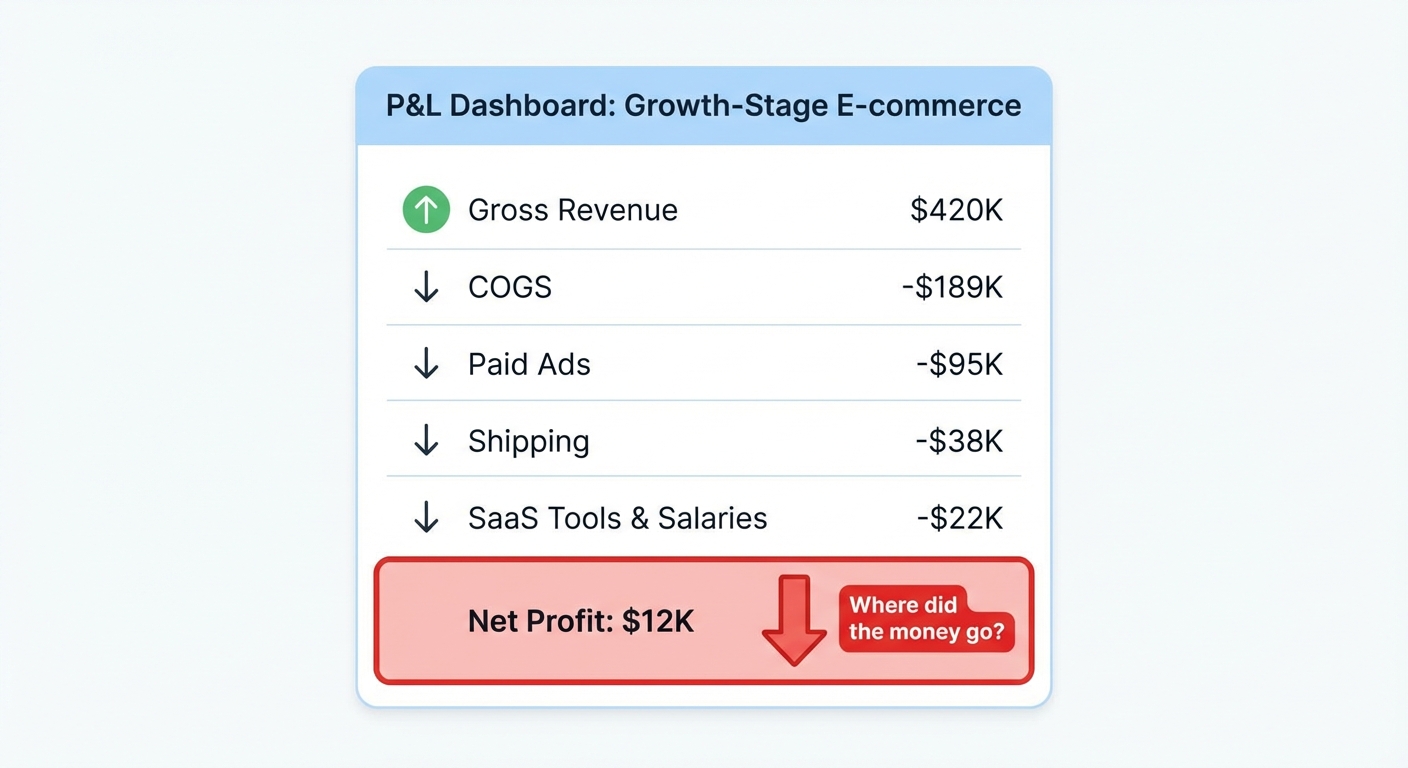
| Line Item | Q1 | Q2 | Q3 | Q4 | YoY Growth |
|---|---|---|---|---|---|
| Revenue | $120,000 | $168,000 | $218,400 | $254,000 | +112% |
| COGS | $54,000 | $75,600 | $98,280 | $114,300 | +112% |
| Gross Profit | $66,000 | $92,400 | $120,120 | $139,700 | +112% |
| Gross Margin % | 55% | 55% | 55% | 55% | — |
| Fulfillment & Shipping | $7,200 | $10,080 | $13,104 | $15,240 | +112% |
| Advertising | $18,000 | $28,800 | $43,680 | $52,000 | +189% |
| Payment Processing (3%) | $3,600 | $5,040 | $6,552 | $7,620 | +112% |
| Subscription/Tools | $2,000 | $2,000 | $2,000 | $2,000 | — |
| Net Profit | $34,200 | $46,480 | $54,784 | $62,840 | +84% |
| Net Margin % | 28.5% | 27.7% | 25.1% | 24.8% | — |
See what's happening? Revenue is doubling. But net margin is compressing. Why? Because advertising spend is growing faster than revenue. You're getting less efficient at acquiring customers.
Eventually, if this trend continues, you hit a wall. Your advertising ROI turns negative. You're no longer profitable per customer. And you've got excess inventory and debt to show for it.
This is the reality of aggressive growth for many e-commerce sellers. And most don't see it coming until it's too late.
The Three Metrics That Actually Matter More Than Revenue
If you want to build a sustainable, profitable e-commerce business, stop optimizing for revenue. Optimize for these three metrics instead.
1. Net Margin % (Profit as a Percentage of Revenue)
This is profit divided by revenue, expressed as a percentage.
If you're making $20,000 profit on $100,000 revenue, your net margin is 20%. This number tells you how much of every dollar you actually keep.
For e-commerce, healthy net margins range from 5% to 20%, depending on category and business model. Luxury goods and high-ticket items tend toward 20%+. High-volume, low-ticket items trend toward 5-10%.
Watch this number like a hawk. If it starts declining while revenue grows, you're buying growth, not earning it.
2. Profit Per Order (Net Profit ÷ Total Orders)
This is the profit you make on each individual sale.
If you're doing 1,000 orders in a month and netting $15,000 profit, your profit per order is $15. That's your unit economics. That's what every new customer is actually worth to you.
Here's the power of this metric: it forces you to think about sustainability. If your profit per order is declining, you know that additional volume isn't actually making you more money. You can see it immediately.
3. Contribution Margin (Sales Price − Variable Costs) ÷ Sales Price
This one's trickier but crucial. Contribution margin is the percentage of each sale that contributes to covering fixed costs and profit.
For a $60 order with $20 COGS and $7 shipping, contribution margin is ($60 − $20 − $7) ÷ $60 = 55%. That $33 goes toward ads, salaries, rent, and profit.
Why does this matter? Because contribution margin tells you whether you can actually afford to scale with profitability. If your contribution margin is 55% and you're spending 40% on advertising, you've got 15% left for everything else. That's tight. Not sustainable.
Tracking contribution margin helps you understand whether your margins can support your growth strategy.
How to Grow Revenue AND Profit Simultaneously
Okay, so the paradox is real. Revenue growth often compresses profit. What do you do about it?
1. Understand Your Unit Economics First
Before you scale anything, know the profit you make per customer. Know your customer lifetime value. Know your break-even CPA.
Many sellers skip this step and just go for volume. Don't be that person.
2. Reduce Customer Acquisition Cost Before Increasing Volume
You don't need to spend more to get more. You need to spend smarter.
Before you double your ad budget, spend time optimizing your existing campaigns. Improve landing page conversion. Refine your audience targeting. A/B test creative. Even a 10-15% improvement in conversion rate is like giving yourself a pay cut to your CPA.
Then scale.
3. Increase Average Order Value Instead of Volume
Adding $5 to your AOV is often cheaper and more profitable than acquiring a whole new customer.
Strategies: product bundling, volume discounts (not percentage discounts), upsells, cross-sells, premium tiers. These strategies raise AOV without raising customer acquisition cost. Better margins, higher profit per order.
4. Be Strategic About Promotions
Discounts work. But they destroy margins. Instead of deep percentage discounts, try:
- Limited-time offers on specific high-margin products
- Free gifts with purchase (costs less than a 20% discount)
- Bundle deals that increase AOV
- Loyalty discounts that reward repeat customers
Each of these drives volume while protecting your margin better than straight price cuts.
5. Optimize Fulfillment and Logistics
Shipping is often 10-20% of revenue for physical product stores. Small optimizations here compound.
Negotiate carrier rates. Use regional warehouses if volume justifies it. Offer slower (cheaper) shipping options. Partner with fulfillment centers to reduce handling costs. Every $0.50 you save per order is pure profit.
6. Monitor Margins by Channel
Not all revenue is created equal. Some sales channels might be highly profitable while others bleed money.
Track profit by:
- Marketing channel (organic vs. paid, Facebook vs. Google, etc.)
- Product line
- Customer segment (new vs. repeat)
- Geographic region
Then double down on high-margin channels and either fix or kill low-margin ones.
[IMAGE PLACEHOLDER: Dashboard showing revenue vs profit by channel]
The Honest Truth
Revenue growth feels good. It's visible. It's shareable. It's a milestone.
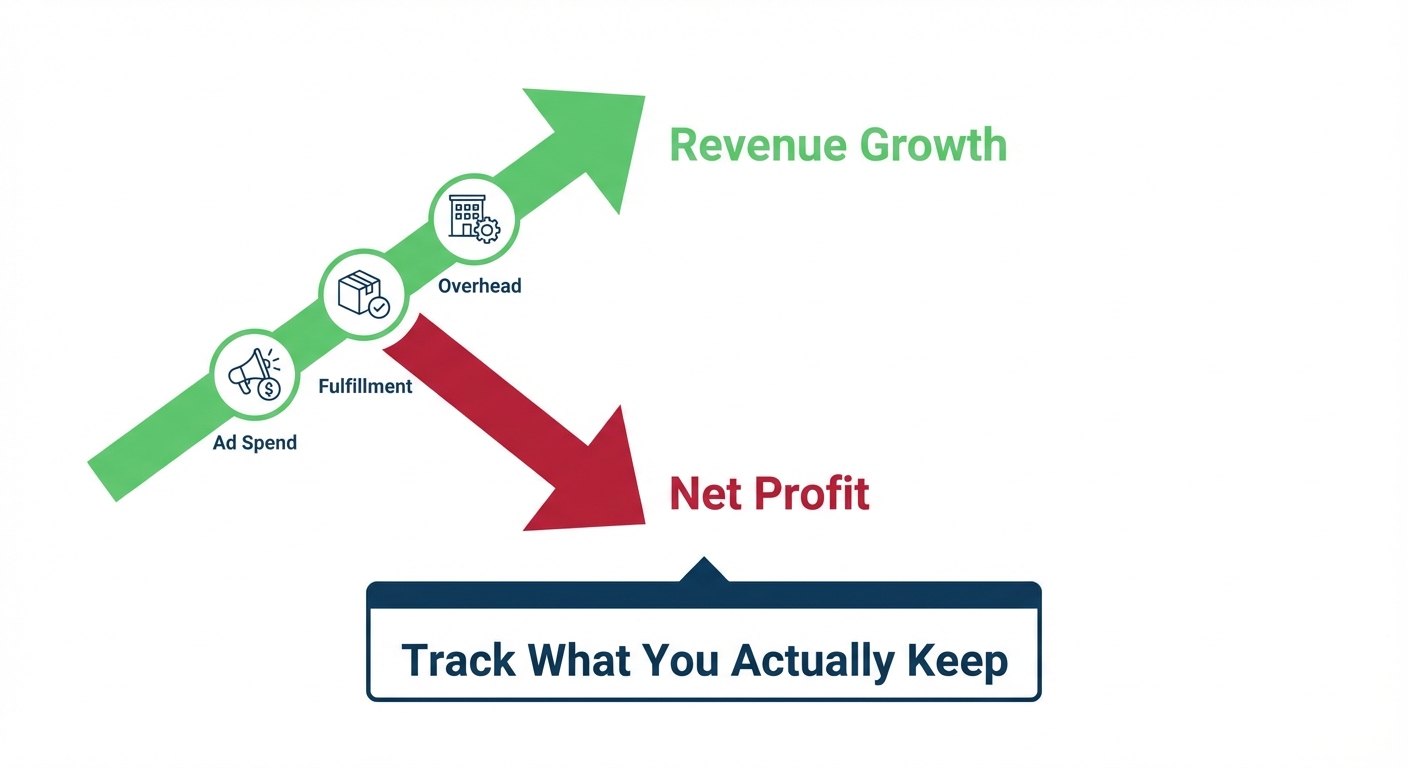
But profit is what actually matters. Profit is what lets you pay yourself. Profit is what lets you invest in your team, your product, your future. Profit is what makes your business real.
Many e-commerce sellers celebrate revenue milestones that are actually costing them money. They're busier, more stressed, making less per order, and on track for burnout or insolvency—even though their revenue number looks great in a screenshot.
Don't be that seller.
Watch your margins. Understand your unit economics. Grow thoughtfully. Profit first, always.
FAQ
Q: Can I have a healthy business with thin margins?
A: Yes, but only if you have high volume and ruthlessly controlled costs. Most e-commerce businesses do better with moderate volume and healthy margins. A 20% net margin on $50k revenue is better than 5% net margin on $100k revenue. Think about scale differently.
Q: What's a "good" net margin for e-commerce?
A: It depends on your category. Commodity products: 5-10%. Branded goods: 10-20%. Luxury items: 20-40%. Niche/specialty: varies widely. Benchmark against your competitors and your own historical performance.
Q: Should I ever run discounts?
A: Yes. But strategically. Use discounts to clear excess inventory, acquire new customers at a cost you can sustain, or reward loyalty. Don't use them to artificially drive volume if it destroys your margin. The volume has to be profitable volume.
Q: How often should I review margins and profit?
A: At minimum monthly. Weekly is better if you're scaling or running promotions. Daily monitoring is overkill unless you're dealing with highly volatile markets. But monthly is the bare minimum.
Q: What's the difference between gross profit and net profit?
A: Gross profit is revenue minus cost of goods sold (COGS). Net profit is gross profit minus all operating expenses (ads, shipping, salaries, tools, rent, etc.). Net profit is what you actually keep. Watch both, but net profit is what matters for your bank account.
Q: If my revenue is growing but profit is flat, should I keep scaling?
A: No. Not until you fix what's causing the margin compression. You're likely overspending on acquisition or underselling your products. Fix the unit economics first. Then scale.
The e-commerce space rewards clarity. And there's no clarity without understanding the difference between revenue and profit.
You've built something real. Don't let vanity metrics—revenue—cost you the thing that matters: profit.
Want to see whether your revenue growth is actually growing profit? Try Shopimize free and track the number that matters.