
What Is a Good Profit Margin for Shopify? Real Benchmarks
If you've ever looked at your Shopify revenue and thought "I should be making more money than this," you're not alone. The number merchants most often fixate on — revenue — tells you almost nothing about the health of your business. What actually matters is your profit margin, and knowing what a good profit margin for Shopify looks like in your specific niche can be the difference between scaling confidently and bleeding out slowly.
This article breaks down real benchmarks across the most common Shopify niches, explains why your margin is probably lower than you think, and gives you a framework for actually improving it.
What is a profit margin, exactly?
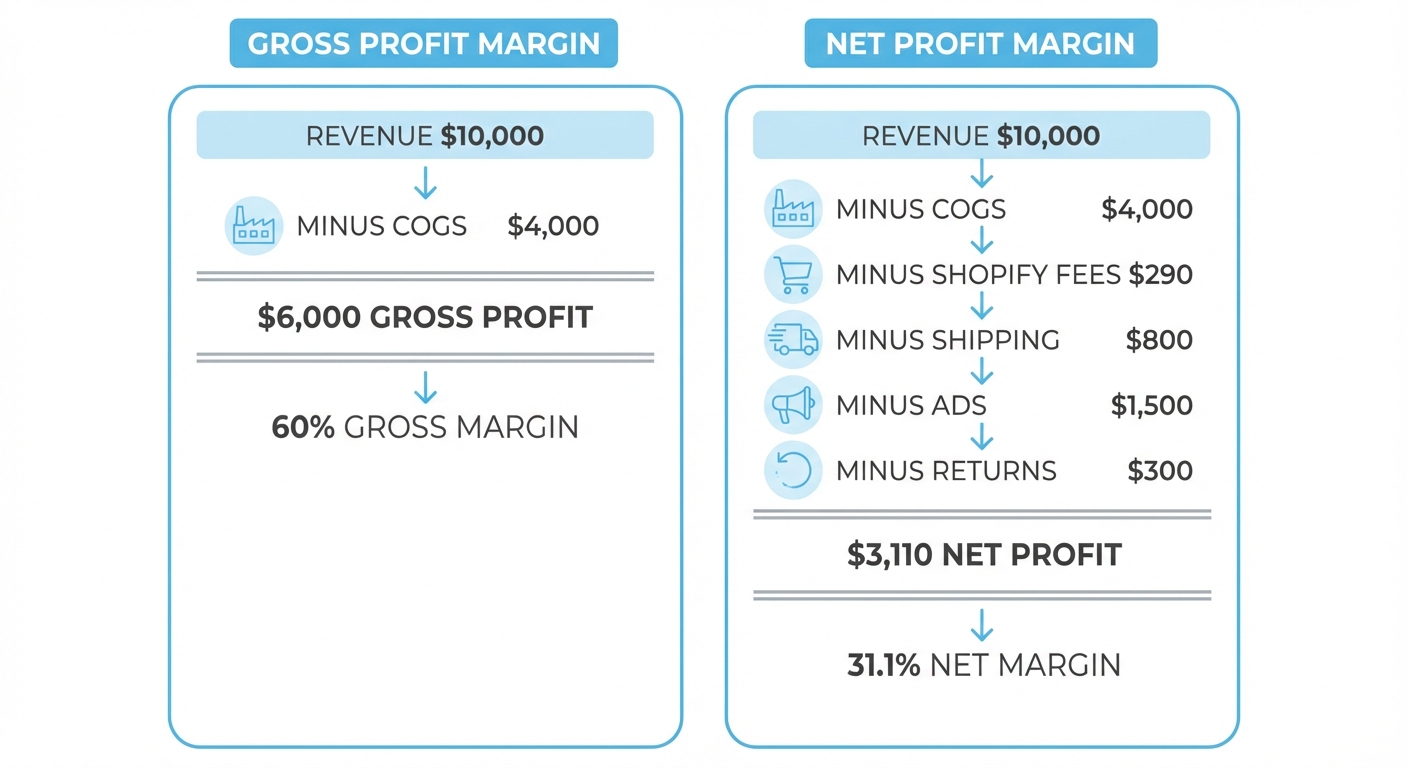
Before we get into numbers, a quick definition. Profit margin is the percentage of revenue you keep after subtracting your costs. There are two versions you'll hear about:
Gross profit margin = (Revenue − Cost of goods sold) ÷ Revenue × 100
Net margin = (Revenue − All costs) ÷ Revenue × 100
The "all costs" in net margin includes your cost of goods sold (COGS), Shopify fees, payment processing fees, shipping, advertising, returns, and any other operating expenses. Net margin is the number that actually tells you whether your business is profitable. Gross margin without knowing your net margin is a bit like celebrating a big sales day without checking what you spent on ads to get there.
Why most Shopify merchants overestimate their margins
Here's a scenario that comes up more than you'd expect: a store doing $40,000 a month in revenue, with a 55% gross margin on paper, discovers after adding up their actual costs that their net margin is somewhere around 8%. That's $3,200 in profit on $40k in sales — less than some people make working part-time.
How does that happen? A few costs that consistently get underestimated:
- Shopify fees: On the Basic plan, you're paying $39/month plus 2% transaction fees if you're not using Shopify Payments. On Shopify Payments, you still pay 2.9% + 30¢ per transaction.
- Returns and refunds: In apparel, return rates can hit 20–30%. If you're not factoring this into your margin calculation, your numbers are fiction.
- Ad spend: Many merchants calculate ROAS (return on ad spend) but don't subtract the actual ad cost from their profit. A 3x ROAS sounds great. But if your gross margin is 40%, a 3x ROAS means you're barely breaking even on the ad-driven portion of your revenue.
- Shipping costs: Free shipping offers are a conversion tool, but someone is paying for that shipping. Usually you.
The math catches up eventually. And it's better to face it now than after you've scaled a business model that doesn't actually work.
Shopify profit margin benchmarks by niche
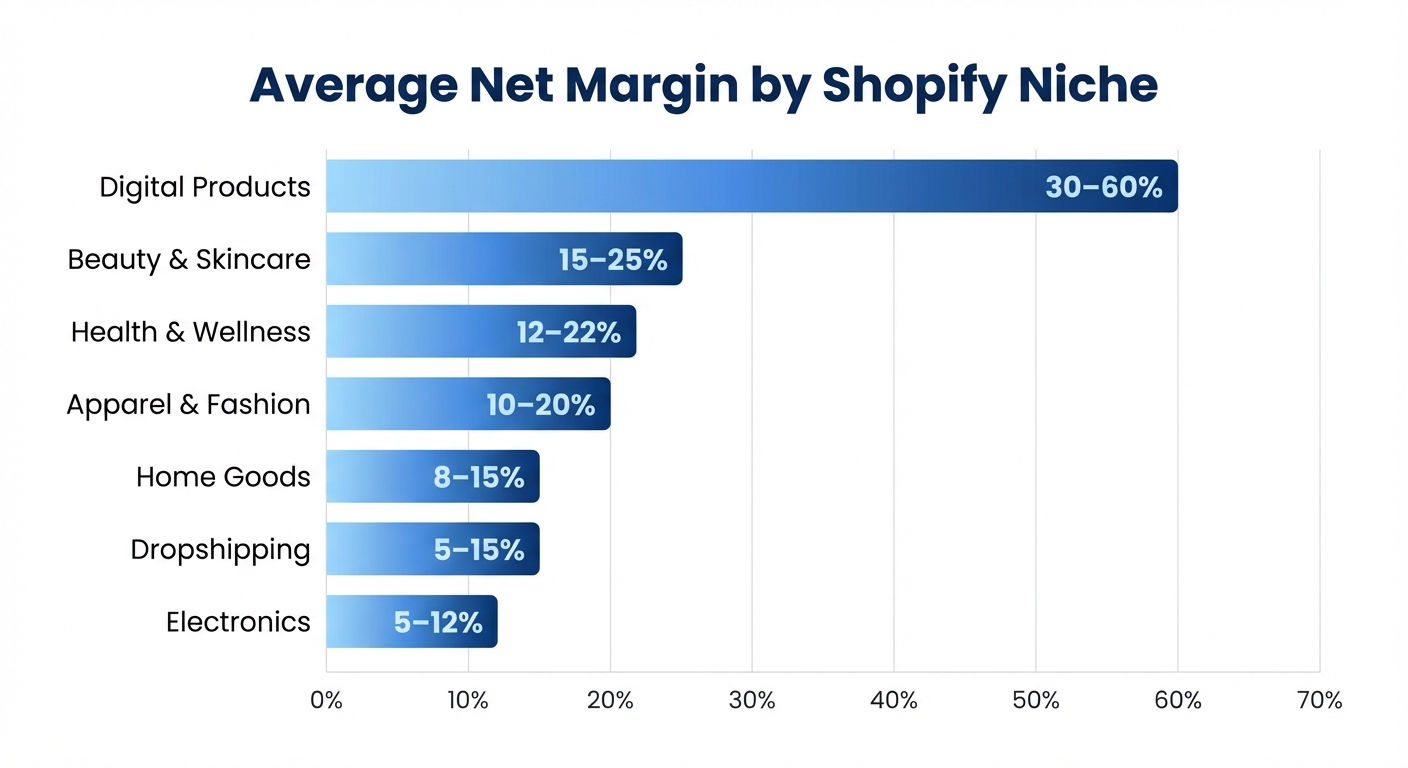
These are realistic ranges based on industry data and what we see across Shopify stores. Every store is different, but these should give you an honest baseline.
Apparel and fashion
Gross margin: 50–65%
Net margin: 10–20%
Apparel has some of the best gross margins in e-commerce — and some of the most margin-destroying hidden costs. Returns are high, sizing exchanges eat into fulfillment costs, and competition means ad costs are punishing. A healthy apparel store hitting 15% net margin is doing well. Under 10% and you should be worried.
Beauty and skincare
Gross margin: 60–75%
Net margin: 15–25%
Beauty products often have excellent unit economics — a moisturizer that costs $8 to make can sell for $45 without raising eyebrows. The challenge is customer acquisition. Beauty is one of the most competitive niches on Facebook and Instagram, so ad spend can quickly erode what looks like a comfortable margin. Brands that build repeat purchase behavior (subscriptions, loyalty programs) tend to protect their net margins better.
Health and wellness / supplements
Gross margin: 55–70%
Net margin: 12–22%
Supplements can have extraordinary margins when you control manufacturing, but regulatory complexity and subscription churn are real costs. If you're selling consumables with a strong repeat purchase rate, your customer acquisition cost amortizes well and net margins can be strong.
Home goods and furniture
Gross margin: 40–55%
Net margin: 8–15%
Lower gross margins here, partly because COGS are higher relative to sale price. Shipping is also brutal — a $200 table that costs $60 to ship wipes out a significant chunk of margin. Stores that can negotiate better freight rates or shift to local fulfillment tend to see better results.
Electronics and tech accessories
Gross margin: 25–45%
Net margin: 5–12%
This is a tough niche for independent Shopify merchants. Electronics margins are compressed, returns are common, and you're often competing against Amazon on price. The stores that survive here are usually in accessories (cases, cables, peripherals) where margins are better, or in a very specific niche without direct commodity competition.
Dropshipping
Gross margin: 20–35%
Net margin: 5–15%
These numbers vary wildly depending on supplier relationships, product selection, and whether you're running paid ads. Many dropshipping stores operate at 5–8% net margins, which sounds fine until you factor in the time invested and the fragility of supplier-dependent businesses. Merchants who do well in dropshipping tend to focus obsessively on ad efficiency and repeat purchase rates.
Digital products and courses
Gross margin: 80–95%
Net margin: 30–60%+
The economics are completely different here. With no physical inventory, no shipping, and no returns (usually), net margins can be extraordinary. The main cost is customer acquisition. A digital product business with a working content or SEO strategy can be genuinely high-margin.
Want to see your real numbers?
Try our free profit calculator — plug in your numbers and see your real net margin in 30 seconds.
Try the free calculator →What is a good profit margin for Shopify, specifically?
Here's a direct answer: a net margin above 15% is genuinely good for most physical product Shopify stores. Above 20% is strong. If you're running a well-optimized physical product store at 20%+ net margin, you're ahead of the majority.
Below 10% net margin is survivable, but fragile. One bad ad campaign, a shipping rate increase, or a slow month can tip you into the red. Below 5% is technically profitable but not resilient — and not worth the effort in most cases.
For reference, Shopify's own published data consistently shows that successful e-commerce businesses aim for 10–20% net margins, with high-margin niches like digital products and beauty exceeding that significantly.
One important nuance: these benchmarks apply to your blended margin across all products. You might have a hero product running at 8% margin and a small accessory that prints at 40%. Knowing which is which — and leaning into the right ones — is where the real work happens.
The four levers that actually move your margin
Rather than listing 20 tactics, here are the four that genuinely move the needle for most Shopify stores.
1. Know your real COGS
Most merchants know their product cost, but not their total landed cost — which includes shipping from supplier, import duties, and storage. If you're sourcing from overseas and not accounting for tariffs and freight, your COGS is understated and your margin is overstated. A product that costs $12 from your supplier might land at $17 after duties and freight. That $5 difference on 500 units per month is $2,500 in margin you thought you had.
2. Audit your ad spend by product
This is where stores leave the most money on the table. Running blended ROAS numbers across your whole store hides the fact that some products are profitable to advertise and others are actively destroying margin. A t-shirt at a $15 margin cannot support the same customer acquisition cost as a skincare bundle at $45 margin. Segment your ad performance by product and cut what doesn't math out.
3. Reduce return rates before you scale
Every $100 return on a 40% gross margin product actually costs you more than $100. You've lost the $60 you spent to acquire and fulfill that order, and you may have a used product you can't resell at full price. In apparel especially, getting return rates down from 25% to 18% can add 3–4 percentage points to your net margin without touching anything else.
4. Renegotiate your shipping costs
Merchants often treat shipping rates as fixed. They're not. If you're shipping more than 100 packages a month, most carriers will negotiate. UPS, FedEx, and even some USPS volume programs offer discounted rates that can save $1.50–$3.00 per shipment. On 200 orders a month, that's $300–$600 back in your pocket — at zero cost to the customer.
Why you probably don't know your actual margin right now
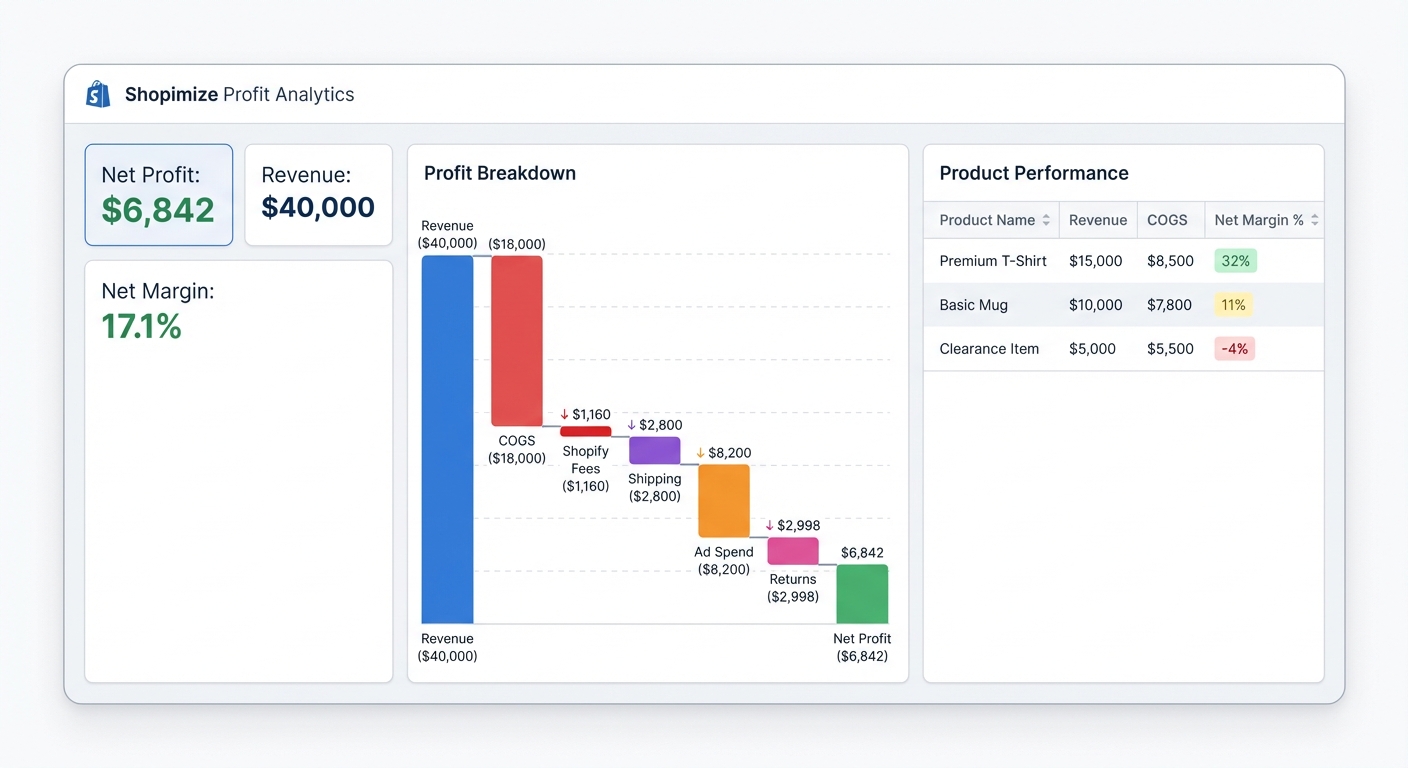
The uncomfortable truth is that Shopify's native analytics don't show you net profit. You can see revenue, and you can see COGS if you've entered it manually — but Shopify doesn't automatically subtract transaction fees, shipping label costs, refund costs, or ad spend from your profit number.
Most merchants end up doing this in spreadsheets, which works until it doesn't. Spreadsheets break, formulas get stale, and nobody updates them weekly when things get busy.
To actually know your margin — product by product, not just store-wide — you need something that pulls all of those numbers together in one place automatically.
Your margin is the only number that matters for long-term growth
Revenue is a vanity metric. Gross margin gets you closer to the truth. But net margin — the profit actually left over after every cost — is the only number that tells you whether you have a sustainable business or an expensive hobby.
Understanding what a good profit margin for Shopify looks like in your niche gives you a benchmark to measure against. But knowing your own actual margin, in real time, is what gives you something to act on.
Shopimize is built specifically for Shopify merchants who want to see that number clearly — without building a spreadsheet from scratch or piecing together data from five different tools. It pulls in your COGS, fees, shipping costs, and ad spend automatically, and shows you your real net margin by product, by order, and by period.
Frequently asked questions
What is a good profit margin for a Shopify store?
For most physical product stores, a net margin above 15% is solid and above 20% is genuinely strong. Net margins below 10% are survivable but leave you vulnerable to cost increases or slow periods. Digital product stores can achieve much higher margins — often 30–50%+ — because there's no inventory or shipping cost involved.
Why is my Shopify profit margin lower than expected?
The most common culprits are advertising costs that eat into margin faster than expected, return rates that aren't being tracked against profit, Shopify transaction fees and payment processing fees, and shipping costs that are partially or fully absorbed by the store. Merchants who add all of these up for the first time are often surprised by how much they reduce the gross margin figure.
How do I calculate my net profit margin on Shopify?
Take your total revenue, then subtract COGS, Shopify subscription and transaction fees, shipping costs, advertising spend, and returns/refunds. Divide that final number by your total revenue and multiply by 100. The result is your net margin as a percentage. Shopify's native reports won't do this calculation for you automatically — you need to either build a manual model or use a profit analytics tool that connects all of those data sources.
What is the average profit margin for dropshipping on Shopify?
Dropshipping stores typically operate with gross margins between 20–35% and net margins of 5–15%, depending heavily on ad efficiency and supplier pricing. Margins on the lower end of that range are common for new stores running paid ads. Dropshipping businesses that reach 15%+ net margin are usually those that have built strong organic traffic or negotiated better supplier terms over time.