
Realistic Dropshipping Margins in 2026 (With Real Numbers)
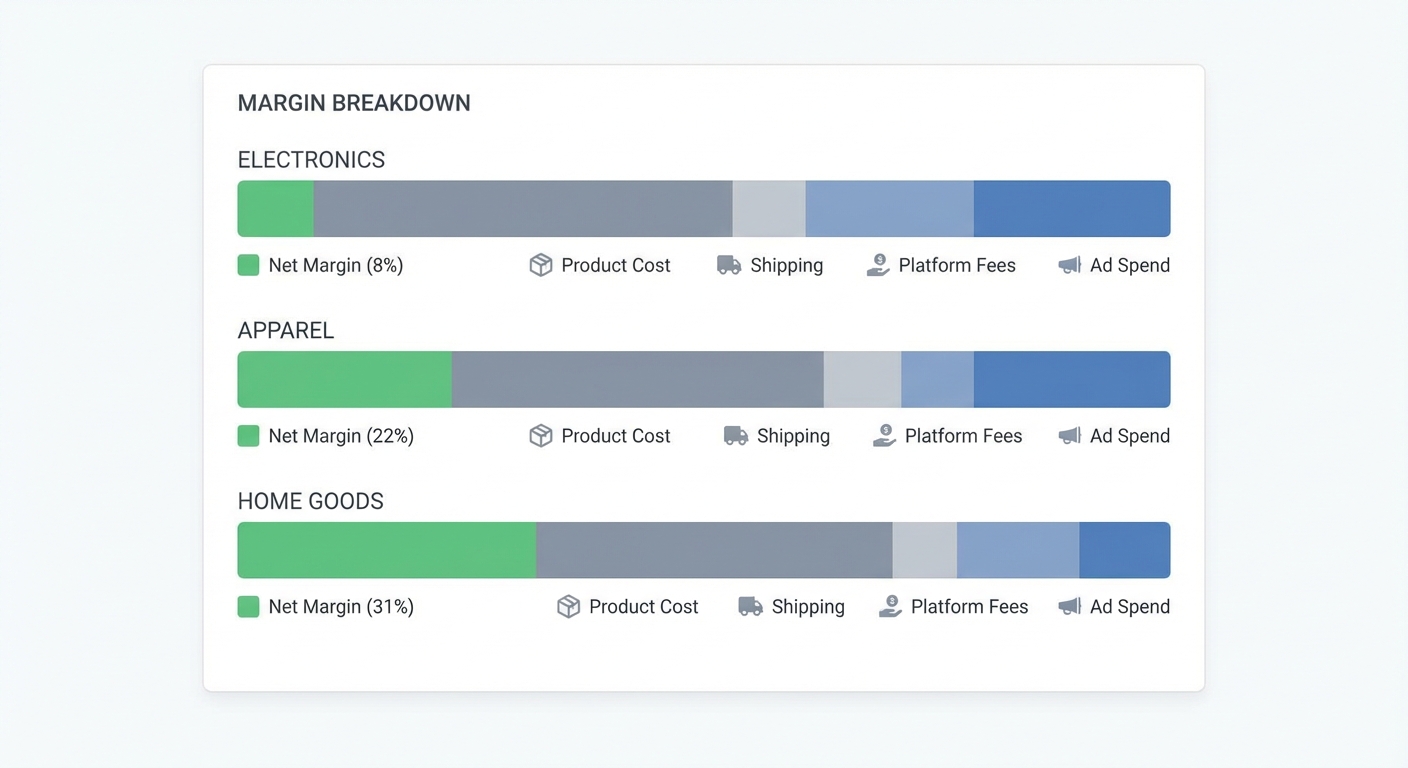
[IMAGE PLACEHOLDER: Dashboard showing profit margin breakdown for a dropshipping product]
Let's be honest: dropshipping margins aren't what the YouTube gurus claim they are.
You've probably seen the ads. Some guy with a Rolex promises 300% profit margins and a "passive income funnel" that runs while you sleep. Maybe you've even bought his course.
Here's the reality. After running real dropshipping stores, tracking actual costs, and analyzing data from hundreds of sellers, we know what margins really look like in 2026. Spoiler: they're thinner than the hype suggests, but they're still achievable if you understand the numbers.
This article walks you through real margin ranges, full cost breakdowns, and what it actually takes to build a profitable dropshipping business.
What Margins Are We Talking About?
First, let's define terms, because "profit margin" gets confused a lot.
Gross profit margin = (Revenue – Cost of Goods Sold) / Revenue × 100
Net profit margin = (Revenue – All Expenses) / Revenue × 100
When someone tells you they're making 100% margins, they usually mean gross margin (revenue minus just the product cost). When we talk about actual profit, we're talking net margin. That's what matters.
The difference between gross and net is where reality bites. Ads, payments processing, refunds, platform fees, returns—these add up fast.
Margin Reality by Dropshipping Model
Not all dropshipping is the same. Here's what realistic margins actually look like in 2026:
AliExpress Standard (Supplier Dropshipping)
This is what most people think of when they say "dropshipping"—sourcing from Alibaba/AliExpress, building a Shopify store, running Facebook/TikTok ads.
| Metric | Low End | Average | High End |
|---|---|---|---|
| Gross Margin | 12% | 25% | 35% |
| Net Margin | 2% | 8% | 15% |
| Typical Order Price | $30 | $50 | $100+ |
| Marketing ROI | 1.5x | 2.0x | 2.5x |
Why the gap? You're competing on price. Supplier costs are squeezed. Customer acquisition is expensive. Returns are high because the product often doesn't match expectations.
Realistic scenario: You sell a $50 product, buy it for $8, ship it for $3. Gross profit is $39. After ads ($20), payment processing ($2), platform fees ($3), and accounting for returns (8% cost recovery loss), you net maybe $8–12. That's 16–24% gross margin, 8–12% net margin.
Private Label (Branded Products)
You source a basic product, rebrand it, and sell under your own brand. Think: a generic water bottle with your logo, or a "signature blend" supplement.
| Metric | Low End | Average | High End |
|---|---|---|---|
| Gross Margin | 35% | 50% | 65% |
| Net Margin | 12% | 20% | 30% |
| Typical Order Price | $40 | $75 | $150+ |
| Marketing ROI | 2.0x | 2.5x | 3.5x |
| Minimum Order Qty | 500 units | 1000 units | 2000+ units |
Why higher margins? You're not racing on price. Customers buy the brand, not the commodity. Return rates are lower. You have breathing room for ads and fulfillment.
Realistic scenario: You sell a private label supplement for $75. You buy 1000 units at $18/unit. Gross profit is $57 per order. After ads ($15), payment processing ($2.25), platform fees ($3), shipping ($5), and returns (5% cost recovery), you net around $25–30. That's 76% gross margin, 25–30% net margin.
The catch: you need startup capital ($18k minimum for inventory), and you're betting on demand.
Print-on-Demand (POD)
T-shirts, hoodies, mugs, posters—you design it, a fulfillment partner prints and ships. Zero upfront inventory cost.
| Metric | Low End | Average | High End |
|---|---|---|---|
| Gross Margin | 18% | 28% | 40% |
| Net Margin | 5% | 12% | 20% |
| Typical Order Price | $25 | $40 | $80+ |
| Marketing ROI | 2.0x | 2.5x | 3.0x |
| Unit Economics | Fixed | Fixed | Variable |
Why moderate margins? POD providers take a cut. Shipping is expensive. Your product has no brand moat—it's easy to copy.
Realistic scenario: You sell a custom hoodie for $60. The POD provider's base cost is $15, you keep $45 gross. After ads ($18), payment processing ($1.80), platform fees ($2), shipping markup ($3), and returns (10% cost recovery), you net around $8–12. That's 75% gross margin, 12–15% net margin. But you run thin and need volume.
Full Cost Breakdown: A $35 Product Case Study
Let's walk through a real example. You're selling a popular kitchen gadget dropshipped from China at $35 USD on Shopify.
Unit Economics (Per Order)
| Cost | Amount | Notes |
|---|---|---|
| Revenue | $35.00 | Customer pays this |
| Supplier Cost | –$6.50 | Alibaba/AliExpress |
| Shipping (Supplier → Customer) | –$3.20 | ePacket, 20–30 days |
| Shopify Fees | –$1.05 | 2.9% + 30¢ for card payments |
| Payment Gateway Fee | –$1.10 | If using Stripe/Square: ~3.15% |
| Ad Spend (Allocated) | –$7.00 | Assume 20% of revenue for acquisition |
| Refund/Return Buffer | –$1.40 | Assume 5% return rate, average 40% refund |
| Other Fees | –$0.50 | Email, customer support, etc. |
| Gross Profit | $14.25 | Before ad spend |
| Net Profit | $6.75 | After all costs |
| Gross Margin | 40.7% | $14.25 / $35 |
| Net Margin | 19.3% | $6.75 / $35 |
On this scenario, you'd need to sell roughly 150 units per month to make $1,000 net profit. That requires consistent ad spend and a decent conversion rate (2%+).
What Happens With Mistakes?
Scenario A: Ad spend climbs to 30% of revenue (realistic when scaling)
- Net margin drops to 9.3% (from 19.3%)
Scenario B: Return rate hits 8% (common in dropshipping)
- Net margin drops to 16.3% (from 19.3%)
Scenario C: Both A and B
- Net margin drops to 6.3% (from 19.3%)
This is why margin tracking matters. Small cost changes compound.
Want to see your real numbers?
Try our free profit calculator — plug in your numbers and see your real net margin in 30 seconds.
Try the free calculator →The "Guru Myth" vs. Reality
| Guru Claim | Reality Check |
|---|---|
| "Make 200% profit margins dropshipping!" | Gross margin maybe 40–50%. Net margin 10–20%. |
| "You'll have passive income—just set it and forget it." | You'll need constant ad spend, product testing, and customer service. It's not passive. |
| "Everyone's making $10k/month!" | Survivorship bias. Most stores fail within 6 months. |
| "Run ads for $1 and get $3 back!" | Possible early. Unsustainable at scale due to ad saturation and diminishing returns. |
| "Overnight success is realistic." | Building a 6-figure store takes 12–18 months minimum. |
| "You don't need capital to start." | True for inventory, but false for ad spend. Budget $500–2000 for testing. |
The Return Problem: A Hidden Margin Killer
Dropshipping has a return rate problem.
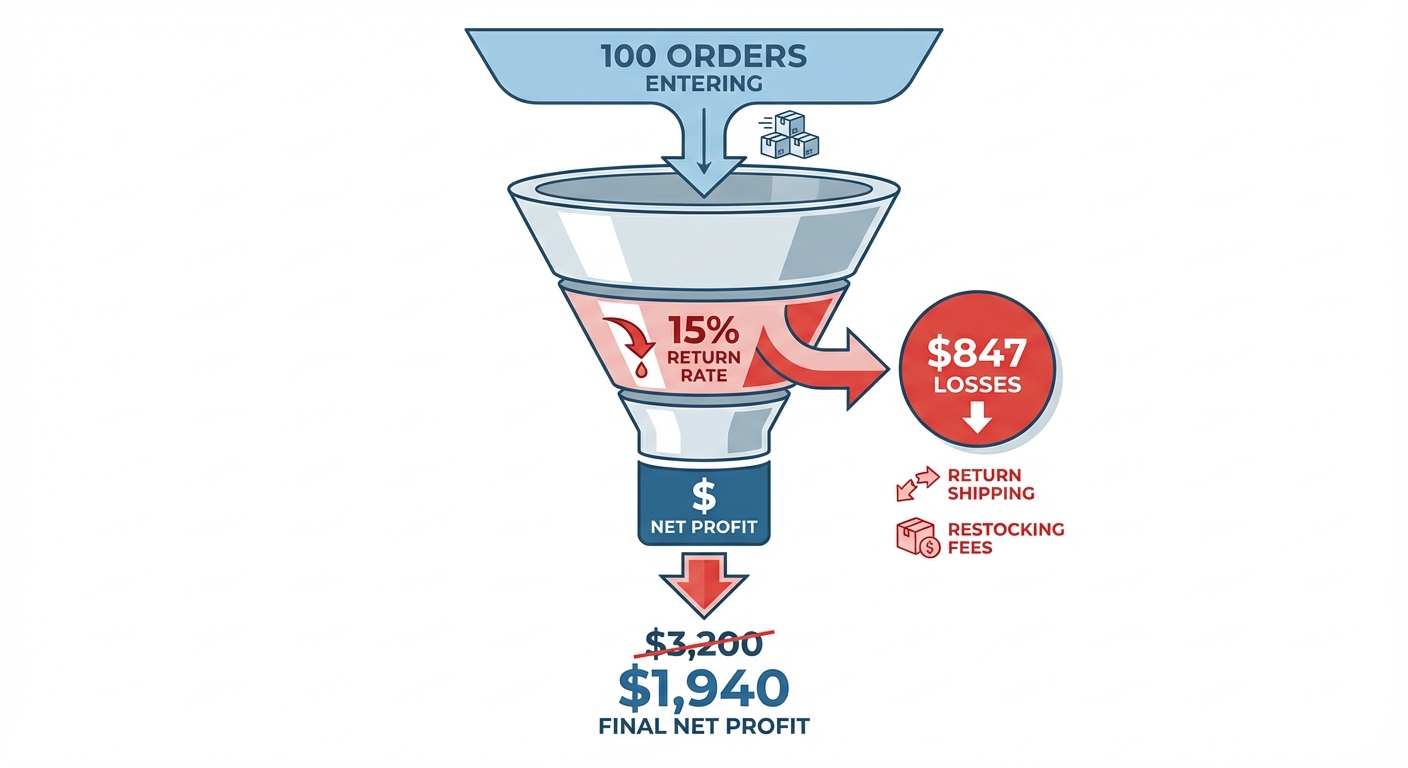
Across industry data, dropshipping stores see 5–15% return rates, depending on product category and messaging. Compare that to:
- Amazon average: 3–5%
- Traditional retail: 2–3%
- High-end DTC: 2–4%
Why the gap? A few reasons:
- Shipping delays. Your customer waits 3 weeks for a $20 item. Expectations sour.
- Quality variance. The picture looked great. The product… didn't.
- No brand trust. She doesn't know you. Returns are risk-free.
- Partial refunds. Many customers try to return after using the product. You eat the loss.
A 10% return rate doesn't just mean 10% fewer sales. It means:
- You refund the full amount (lost revenue).
- You lose the product (lost COGS).
- You incur return shipping (lost 10–20% of the original shipping cost).
- Chargeback risk increases.
On a $35 product with $6.50 COGS and $3.20 shipping, a single return costs you approximately $9.70 in hard cost, plus payment processing refunds.
If you budgeted for 5% returns but hit 10%, your net margin assumption drops by roughly 3–5 percentage points.
5 Ways to Actually Improve Dropshipping Margins in 2026
If thin margins are the reality, how do you build a sustainable business? Here are the moves that actually work:
1. Find Products with Real Differentiation
Don't sell the same bestseller everyone else does. Find a product with a twist:
- A variant that fills a gap (lightweight version, color options).
- A product for a specific niche (left-handed tools, eco-friendly alternative).
- Better packaging or bundling (selling with complementary items).
Differentiation reduces competition and lets you hold margin.
Real example: Instead of selling generic phone cases, sell "waterproof rugged cases for construction workers" with a targeted brand message. You pay the same or slightly more, but you command higher price and lower ad spend.
2. Reduce Return Rates
Every percentage point of return rate you eliminate is 1.5–2% direct margin improvement.
- Better photos and videos. Show the product at scale, in use, from multiple angles.
- Honest descriptions. Under-promise and over-deliver. If it takes 3 weeks, say 4.
- Quality checks before shipping. Inspect 5–10% of incoming inventory. Catch defects early.
- Proactive support. Answer questions before they become returns.
This is unsexy but works. A store that cuts returns from 8% to 4% increases net margin by 2–3 percentage points without touching ads.
3. Build Email and Repeat Customers
Customer acquisition is expensive. Repeat customers are cheap.
- Run a simple email campaign (Klaviyo, Omnisend).
- Offer a 10% discount on the next purchase.
- Build a loyalty program if the unit economics work.
Repeat customers have a lower CAC (customer acquisition cost), which improves margin. And they're more forgiving of longer shipping times because they know you.
A store with 20% repeat purchase rate improves overall margin by roughly 2–4 percentage points because you're not re-acquiring the same customer every month.
4. Negotiate Better Costs or Pivot to Higher-Margin Models
If you're locked into a product with razor-thin margins, you have options:
- Negotiate with suppliers. Once you're ordering 100+ units per month, suppliers will negotiate.
- Move to private label. If a product is selling well, private label it. Overnight, your margin jumps 15–25 percentage points.
- Bundle products. Sell 2–3 items together. Customers perceive more value. You can raise the price 20–30% with bundle psychology.
5. Optimize Your Ad Spend
This is table stakes, but worth spelling out:
- Test creative aggressively. Video, carousel, static—find what your audience responds to.
- Use lookalike audiences. Build from your best customers, not your broad interest guesses.
- Lower your CAC thresholds. If your net margin is 15%, you need an ROAS (return on ad spend) of 2.3x+ to remain profitable long-term. Plan for it.
- Platform diversify. Facebook ads get saturated. TikTok and Google Shopping often have lower CPMs.
A 20% improvement in ROAS (going from 2.0x to 2.4x) increases your net margin by 2–3 percentage points.
Is Dropshipping Still Worth It in 2026?
Short answer: yes, but with caveats.
Dropshipping works if you:
- Understand margins as we've outlined them.
- Have $500–2000 for ad testing.
- Are willing to invest 6–12 months before hitting real profit.
- Can stomach competition and adapt product selection.
- Treat it like a real business, not a lottery ticket.
Dropshipping doesn't work if you:
- Expect 100%+ net margins.
- Won't do customer service.
- Can't manage cash flow (ad spend upfront, revenue delayed).
- Copy other bestsellers without differentiation.
- Expect passive income.
The margins are thin and getting thinner, but they're still real. A store doing $5k/month in revenue at 12% net margin is netting $600/month—not life-changing money, but real money. A store doing $20k/month is netting $2,400/month, which is solid part-time income or the foundation of a full-time business.
The key is knowing your numbers.
FAQ
Q: What's a "good" dropshipping margin?
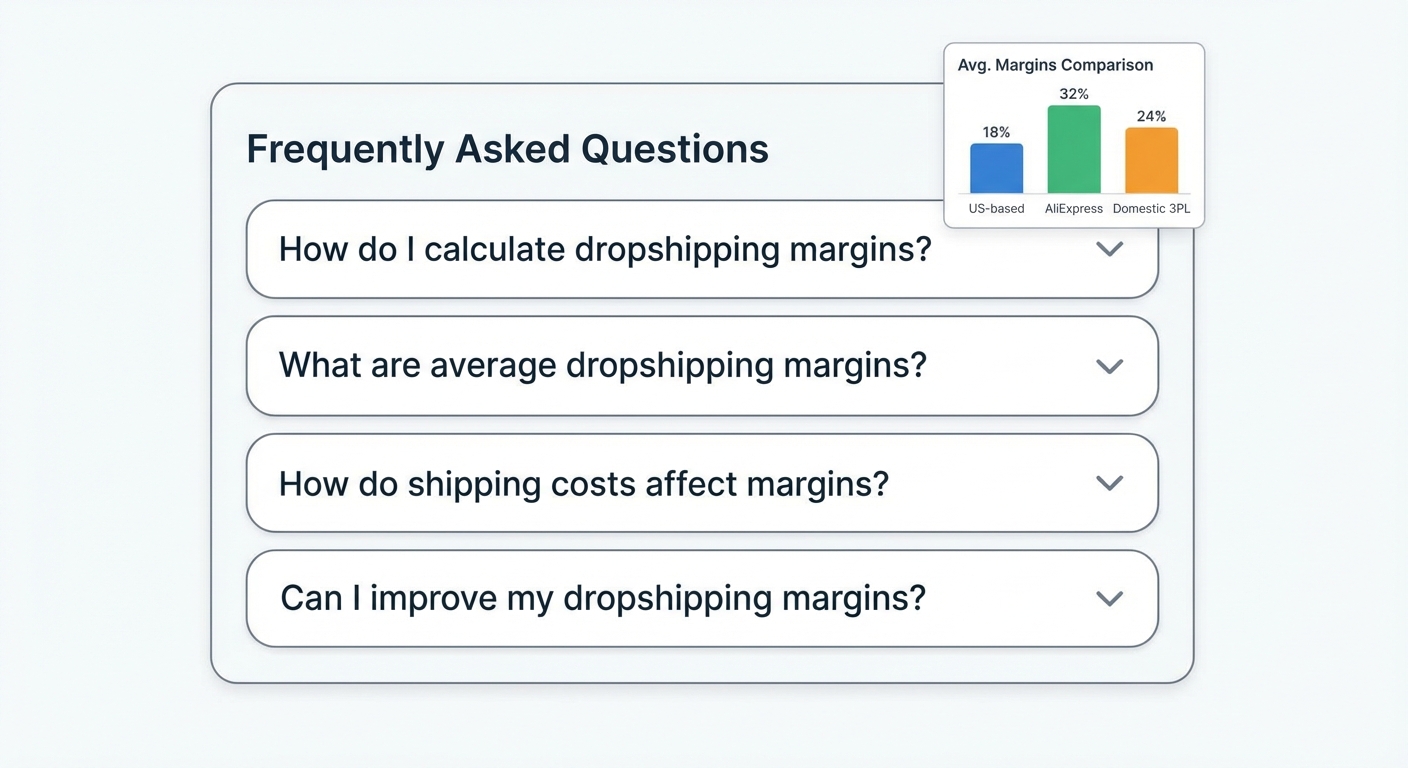
A: Aim for 8–15% net margin. That's realistic and sustainable. Anything above 15% suggests either you've found a genuinely differentiated product or you're not accounting for all costs.
Q: Should I dropship or do private label instead?
A: Private label offers higher margins (20–30% net) but requires upfront capital and inventory risk. Dropshipping has lower barriers but lower margins. Start with dropshipping to validate demand, then private label winners.
Q: How much should I spend on ads per order?
A: The math is simple: if your net margin is 15% and your order value is $50, you net $7.50 per order. Don't spend more than $3–4 on ads per order if you want long-term profitability.
Q: Why is my ROAS good but I'm still losing money?
A: You're probably not accounting for all costs. Look at net margin, not just ROAS. A 2.0x ROAS looks great until you realize your actual profit per order is negative once you factor in returns, refunds, and overhead.
Q: Can I make $10k/month dropshipping?
A: Yes, but you need 2–3 stores or a single store at $80–100k/month revenue at 12% net margin. It's possible but requires 12–24 months of focused work.
Q: How do I know if I'm tracking margins correctly?
A: Use Shopimize or a similar tool to automatically pull COGS, ad spend, and revenue data. Manual spreadsheets miss costs. You need automation to see the real picture.
The Bottom Line
Dropshipping margins in 2026 are real, but they're honest. You're looking at 8–15% net margin for a well-run store, not 50–100% as the gurus promise.
The good news: at that margin, a store is viable. The bad news: you need volume, discipline, and patience.
Stop chasing the myth. Start tracking the numbers.
Want to track your real dropshipping margins—per product, per supplier, per day? Try Shopimize free and stop guessing.