
What's a Good Profit Margin for a Small E-commerce Business?
You've just launched your store. Sales are coming in. But then comes the question that keeps you up at night: Am I actually making money?
You Google "ecommerce profit margin benchmark" and find 30 different answers. Some say 50%. Some say 5%. None of them seem to match your situation.
Here's the honest truth: there's no universal "good" margin. But there's absolutely a healthy margin for where you are right now.
The Short Answer
For most small e-commerce businesses, a net profit margin of 10–20% is healthy. This means that for every $100 in sales, you're keeping $10–$20 as actual profit after all expenses.
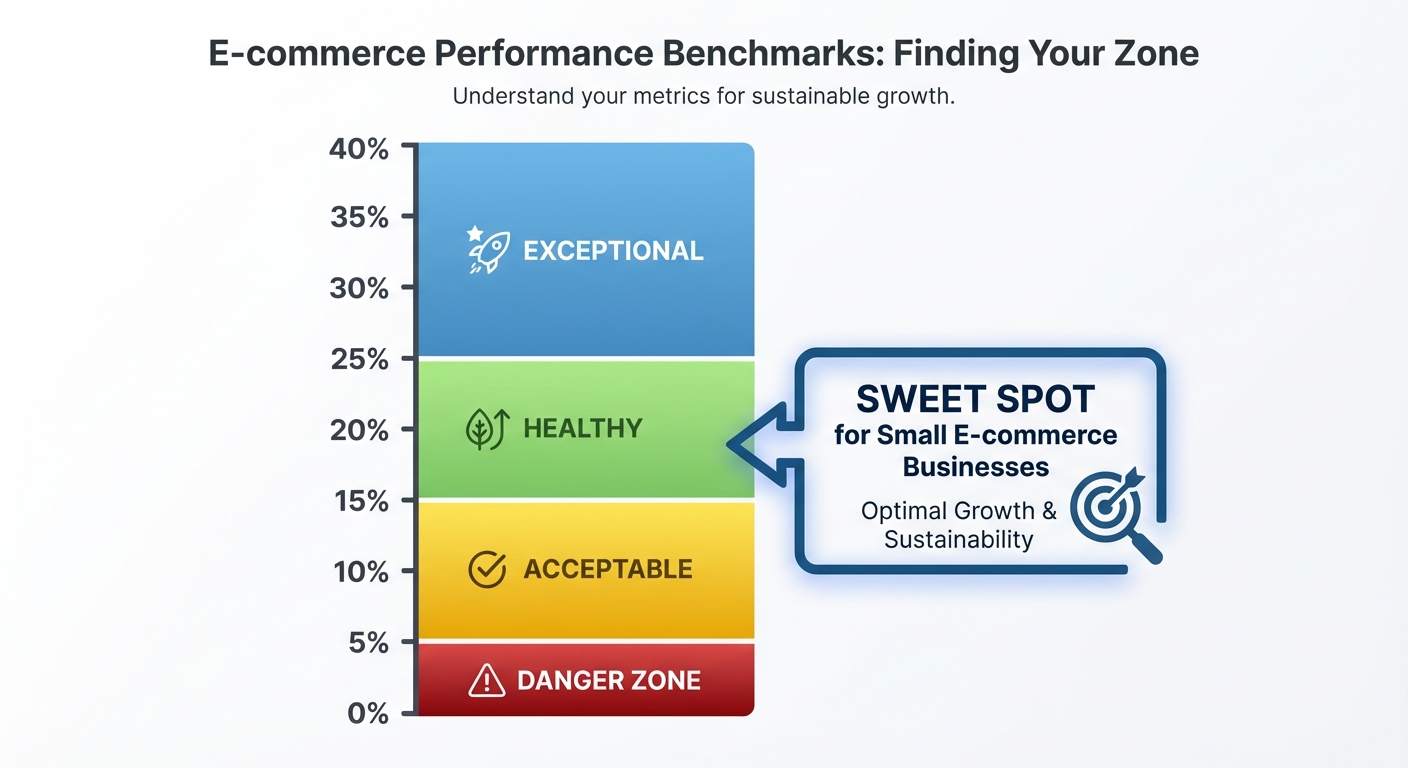
But here's the catch: if you're in year one, you might be hitting 0% or even negative. And that's okay. If you're in year three and still at negative, that's a problem.
Your stage of growth matters more than your niche.
Gross vs. Net Margin: Which One Actually Matters?
Before we go further, let's nail down terminology. People often confuse these two, and it costs them.
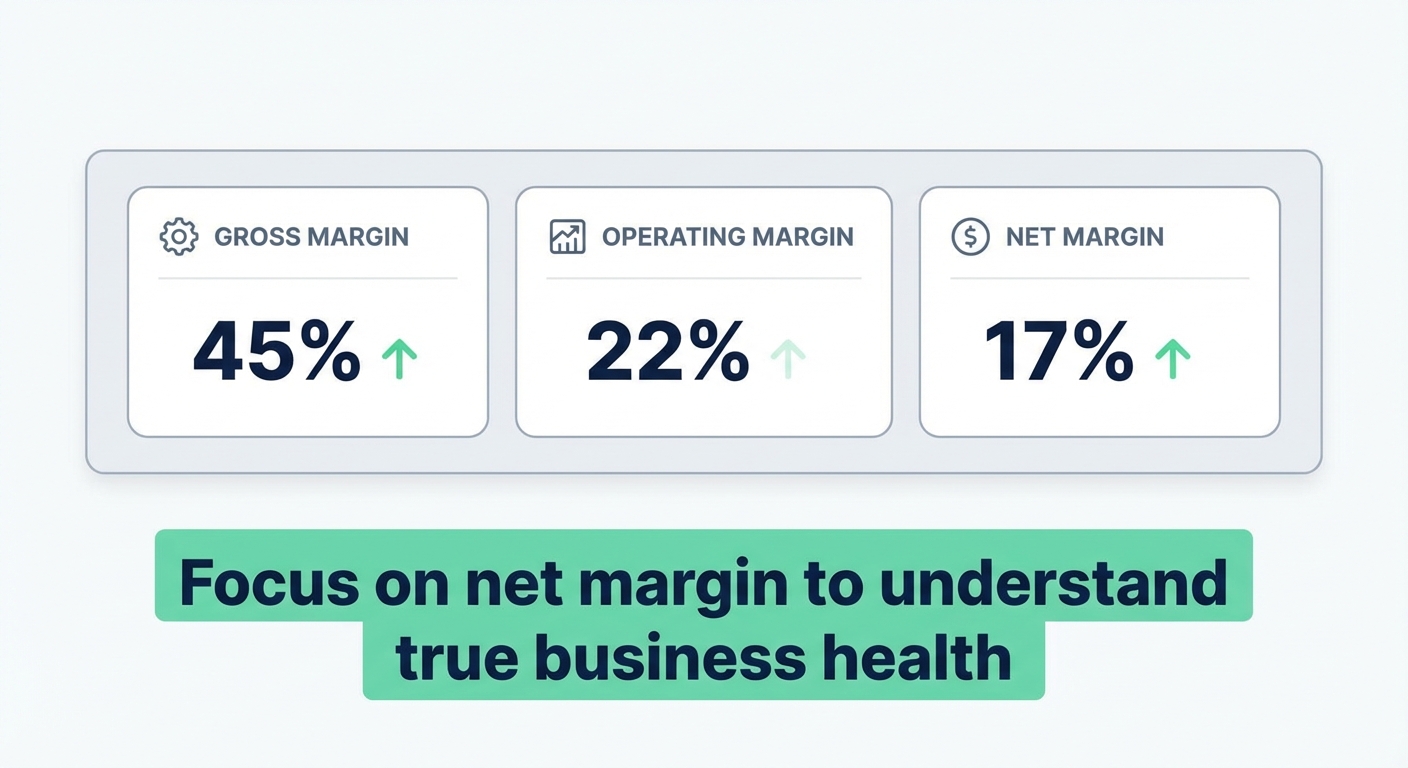
Gross margin = (Sales − Cost of Goods Sold) / Sales
This is your margin before operating expenses. It tells you how much room you have to pay your people, your ads, your rent, your software subscriptions, and everything else.
Net margin = (Sales − All Expenses − COGS) / Sales
This is your actual profit. The money that lands in your bank account.
When someone brags about their 60% margin, they're usually talking gross margin. That's great data — but it doesn't pay your electric bill.
[IMAGE PLACEHOLDER: Diagram showing the waterfall from Revenue → COGS → Gross Profit → Operating Expenses → Net Profit]
Here's what healthy looks like:
| Business Model | Healthy Gross Margin | Healthy Net Margin |
|---|---|---|
| Dropshipping | 40–60% | 5–15% |
| Reselling / Arbitrage | 30–50% | 5–10% |
| Private Label | 50–70% | 15–25% |
| Handmade / Crafted | 60–80% | 20–35% |
| Digital Products | 80–95% | 60–85% |
Notice something? Higher gross margins don't guarantee higher net margins. A handmade business with 75% gross margin might still hit only 20% net if they're spending heavily on fulfillment, packaging, and customer service.
A dropshipping store with 45% gross margin might hit 12% net if they run lean operations and keep ad spend efficient.
It's not about the gross number — it's about the gap between your costs and your ceiling.
The Stage Framework: Why Year 1 Looks Nothing Like Year 3
This is the part that actually matters.
Year 1: The Foundation Phase
You're learning the game. You're reinvesting everything.
Expected net margin: 0% to 10% (sometimes negative)
In year one, you're likely spending on:
- Paid ads while you learn what works
- A designer to make your site not look like a 2004 Blogger template
- Product samples and testing
- Equipment, software, tools
- Inventory reserves
If you're hitting 5% net in year one, you're ahead of the curve. You're probably not spending enough on growth.
The right question: "Are my unit economics sound, and is my traffic growing?" Not "Am I profitable yet?"
Year 2: The Refinement Phase
You've learned what works. You're scaling what works.
Expected net margin: 5% to 15%
You're optimizing ad spend. You're finding your profitable customer acquisition channels. You're starting to see repeatability.
You should be seeing margins tick up as:
- Customer acquisition cost (CAC) drops (more efficient ads, word-of-mouth)
- Repeat customer rate climbs
- Operational friction decreases
Year 3+: The Optimization Phase
You know your business. You're running it.
Expected net margin: 15% to 30%+
You've built systems. You're not learning anymore — you're executing and optimizing.
If you're here and still below 10% net margin, that's a sign something's structurally wrong with your cost base or pricing.
Want to see your real numbers?
Try our free profit calculator — plug in your numbers and see your real net margin in 30 seconds.
Try the free calculator →The Margin Health Check
Here's a simple framework to know where you stand right now.
Green Zone: >15% Net Margin
- You're profitable and can reinvest or take money out
- You have cushion for unexpected costs
- You're free to focus on growth, not survival
- Action: Scale what's working
Yellow Zone: 5–15% Net Margin
- You're profitable, but running thin
- One bad month or unexpected cost can hurt
- You have some flexibility, but limited
- Action: Find 3 cost levers to pull (see below) AND 3 revenue levers
Red Zone: <5% Net Margin (or negative)
- You're not really profitable, even if you're hitting positive revenue
- Your business is fragile
- Every $ of sales is mostly leaving as costs
- Action: Don't expand. Fix the unit economics first.
How to Find Your Margin Right Now
- Take your last 12 months of revenue.
- Subtract COGS (every product-specific cost).
- Subtract operating expenses (ads, tools, payroll, shipping, packaging, everything).
- Divide by total revenue. That's your net margin %.
- Compare to your stage. Are you green, yellow, or red?
If you're honestly not sure what your expenses are, that's the real problem. You can't fix what you don't measure.
Three Real Examples
Example 1: Maya's Candle Shop (Year 1)
Revenue: $25,000 / month
- COGS: $8,000 (wax, wicks, containers, labels)
- Gross Margin: 68%
- Operating Expenses: $14,000 (ads $6,000, software $500, packaging $2,000, part-time help $4,500, shipping supplies $1,000)
- Net Profit: $3,000
- Net Margin: 12%
Stage: Year 1. She's spending aggressively on growth. This is healthy.
Example 2: Raj's Dropship Electronics Store (Year 2)
Revenue: $40,000 / month
- COGS: $24,000 (supplier cost)
- Gross Margin: 40%
- Operating Expenses: $12,000 (ads $8,000, platform fees $2,000, customer service $1,500, tools $500)
- Net Profit: $4,000
- Net Margin: 10%
Stage: Year 2. Thin margins but growing fast. Ads are still expensive. This is okay for now, but he needs to watch that CAC closely.
Example 3: Sofia's Private Label Skincare (Year 3)
Revenue: $75,000 / month
- COGS: $22,500 (manufacturing, packaging, supplier costs)
- Gross Margin: 70%
- Operating Expenses: $37,500 (ads $15,000, team salaries $15,000, fulfillment $4,000, software $2,500, other $1,000)
- Net Profit: $15,000
- Net Margin: 20%
Stage: Year 3. Established brand. Good margins. Can afford to invest in team.
Is 5% Margin Okay? The Honest Answer
It depends.
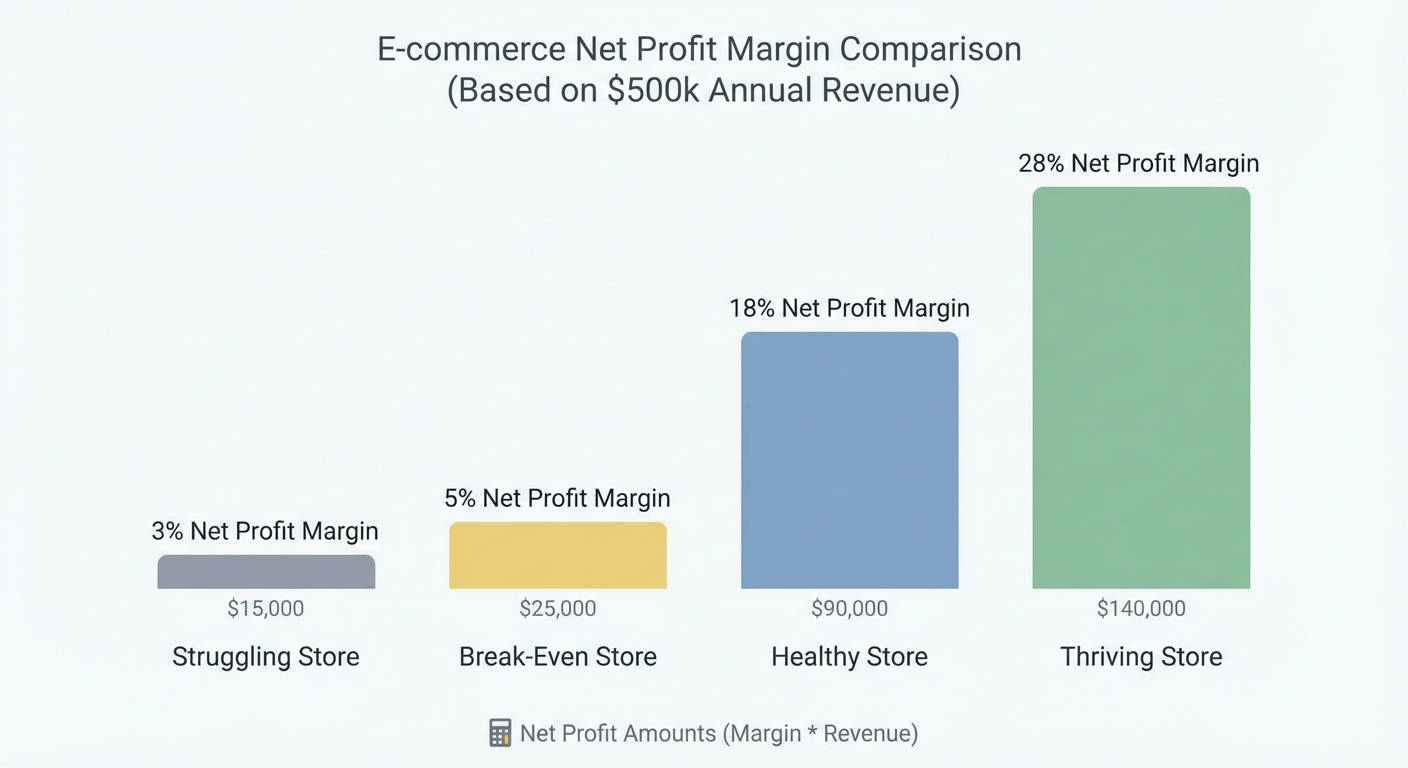
If you're year 1 or 2 and growing 20%+ month-over-month: Yes. You're investing in growth. That's the right call.
If you're year 3+ and flat or shrinking: No. You're treading water. You need to either raise prices, cut costs, or fundamentally change your business model.
If you're stuck at 5% and stalled out: This is dangerous. You have no margin for error. One big customer lost, one supplier increase, one algorithm change — and you're unprofitable.
Don't confuse "reinvesting profits" with "not having profits." Reinvestment means you had profit to reinvest. Running at 2% margin isn't investment — it's survival.
Margins by Business Model
Your model shapes your math.
Handmade / Craft
You make your own products.
- Gross margin: 60–80%
- Net margin target: 25–40%
- Cost drivers: Your time, materials, packaging
- Margin killer: Underpricing your labor
Your time is your biggest cost. Don't treat it as free. Price accordingly.
Reselling / Arbitrage
You buy existing products and resell them.
- Gross margin: 30–50%
- Net margin target: 8–15%
- Cost drivers: Supplier margins are thin, so volume matters
- Margin killer: Inefficient fulfillment; too much storage
Your edge is finding better suppliers or volume. Operational efficiency is everything.
Private Label
You contract manufacturing of a product with your branding.
- Gross margin: 50–75%
- Net margin target: 20–35%
- Cost drivers: MOQ costs, supplier reliability, brand building
- Margin killer: Buying too much inventory; underpricing to compete
You need scale to make this work. Don't compete on price — compete on brand and experience.
Dropshipping
You take orders and a supplier ships on your behalf.
- Gross margin: 35–55%
- Net margin target: 5–15%
- Cost drivers: High customer acquisition costs, narrow supplier margins
- Margin killer: Inefficient ad spend; poor customer retention
Volume is your only leverage. Focus ruthlessly on CAC and repeat customers.
6 Actionable Levers to Improve Your Margins
You can't improve what you don't measure. But once you know your margin, here are the levers:
1. Raise Your Prices
Most small sellers underprice.
Quick test: Raise prices 10% on your top 3 products for 2 weeks. Track conversions. If you lose fewer than 10% of customers, you've found money you're leaving on the table.
Pricing isn't about cost + markup. It's about value delivered. If your customer saves time, money, or frustration, they'll pay for it.
2. Reduce COGS
Talk to your suppliers. Can you negotiate a 5% discount at higher volume? Switch to cheaper materials? Redesign the product to use less material?
A 2% COGS reduction on $100k in annual revenue is $2,000 back in your pocket.
3. Cut Ad Spend Efficiency (Not Volume)
Don't slash ads entirely. Instead, ruthlessly kill underperforming channels.
- Which traffic source has the lowest CAC?
- Which products have the highest repeat rate?
- Where should you increase spend?
Cap underperforming ad channels at 20% of budget. Pour the rest into winners.
4. Increase Repeat Customers
A repeat customer costs 5–10% as much to acquire as a new one.
- Add an email list (offer a discount for signup)
- Create a loyalty program
- Follow up after purchase
- Make reordering frictionless
If you can increase repeat rate from 20% to 30%, your margins get better without changing anything else.
5. Reduce Operational Friction
Where are you bleeding money on process?
- Manual order entry? Automate it.
- Separate shipping on each order? Batch and negotiate rates.
- Handling chargebacks manually? Prevent them with better product descriptions.
- Customers asking the same questions? Create an FAQ.
Each 1% of revenue saved on operations falls straight to the bottom line.
6. Raise Order Value
If you increase average order value by 15%, your margin often increases too (your fixed costs stay mostly fixed).
- Upsells (related products)
- Bundle deals
- Free shipping threshold (encourages bigger orders)
- Gift with purchase (if margin allows)
FAQ
Q: What if my niche has lower margins than the benchmarks?
A: That's okay. Some niches are inherently competitive. But be honest: are you winning in that niche? If your margins are below your target but you're growing faster than competitors, you're trading margin for market share. That's a deliberate choice. Make sure it's intentional.
Q: Should I match my competitor's price?
A: Not automatically. Your costs might be different. Your audience might perceive value differently. Your repeat rate might be higher. Compete on value, not price.
Q: I'm in year 1, negative margin. Should I panic?
A: No. But track your burn rate. How many months of runway do you have before you need to be cash-flow positive? Plan for that.
Q: Is there a profit margin that's "too high"?
A: If you're hitting 60%+ net margin, either you've built something genuinely special, or you're underpricing. The latter is more common. Test a 10% price increase.
Q: How often should I recalculate margin?
A: Monthly. Set a calendar reminder. Margin is a leading indicator of problems. If it drops 2–3% suddenly, figure out why now, not in the quarterly review.
The Bottom Line
A "good" profit margin isn't a number you find on the internet. It's a number you build toward, stage by stage.
- Year 1? Shoot for 5–10% net, reinvest the rest.
- Year 2? Push toward 10–15% net, starting to run sustainably.
- Year 3+? Target 15%+ net, you should be profitable and buildable.
If you're below these benchmarks for your stage, don't despair. Just pick one of the six levers above and pull it hard for 30 days. One small win compounds.
And if you don't know your margin right now? That's today's project. Grab your last 12 months of data, run the numbers, and see where you actually stand.
You might be shocked. You might be thrilled. Either way, you'll know.
Ready to Stop Guessing?
Want to know your real margin — not a guess? Try Shopimize free and see exactly where you stand.
Stop piecing together data from spreadsheets. Get clear visibility into your margins by product, channel, and time period. Make better decisions. Keep more money.
Try Shopimize — free, no credit card required.