
How Shipping Costs Destroy Your Margins (And 5 Ways to Fix It)
You're doing $200k in monthly revenue. Your average order value is $45. Your margins look healthy on paper.
Then you ship an order cross-country. Cost: $8.50. Your profit on that $45 order just dropped by 19%.
Multiply that across 4,000 orders a month, and you've handed $34,000 directly to UPS or FedEx. Before paying for staff, ads, or packaging.
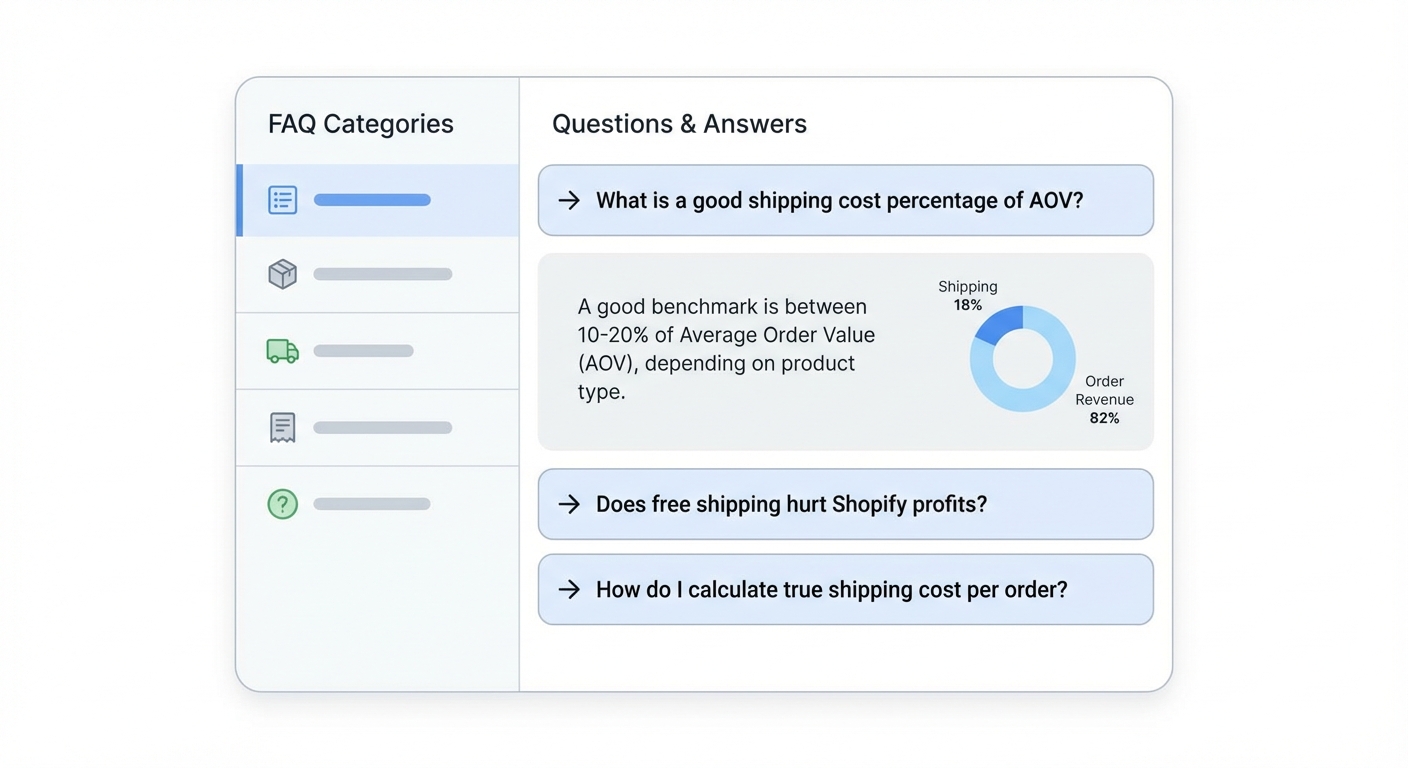
If this number doesn't keep you up at night, it should. Shipping isn't a small line item anymore — it's often the second-largest expense on your P&L, right behind cost of goods sold. For many e-commerce stores, it's eating 10–20% of revenue.
The problem? Most merchants never look at it. They ship everything, charge what their platform suggests, and hope customers don't feel stung at checkout.
That's leaving thousands on the table every month.
Let's look at what's actually happening with your shipping costs, and then I'll show you five concrete fixes that real stores are using to reclaim 5–15% in margin.
The Shocking Math: Why Your AOV Isn't Enough
[IMAGE PLACEHOLDER: Line graph showing shipping costs as percentage of revenue over time, starting at 8% and creeping up to 18% over two years]
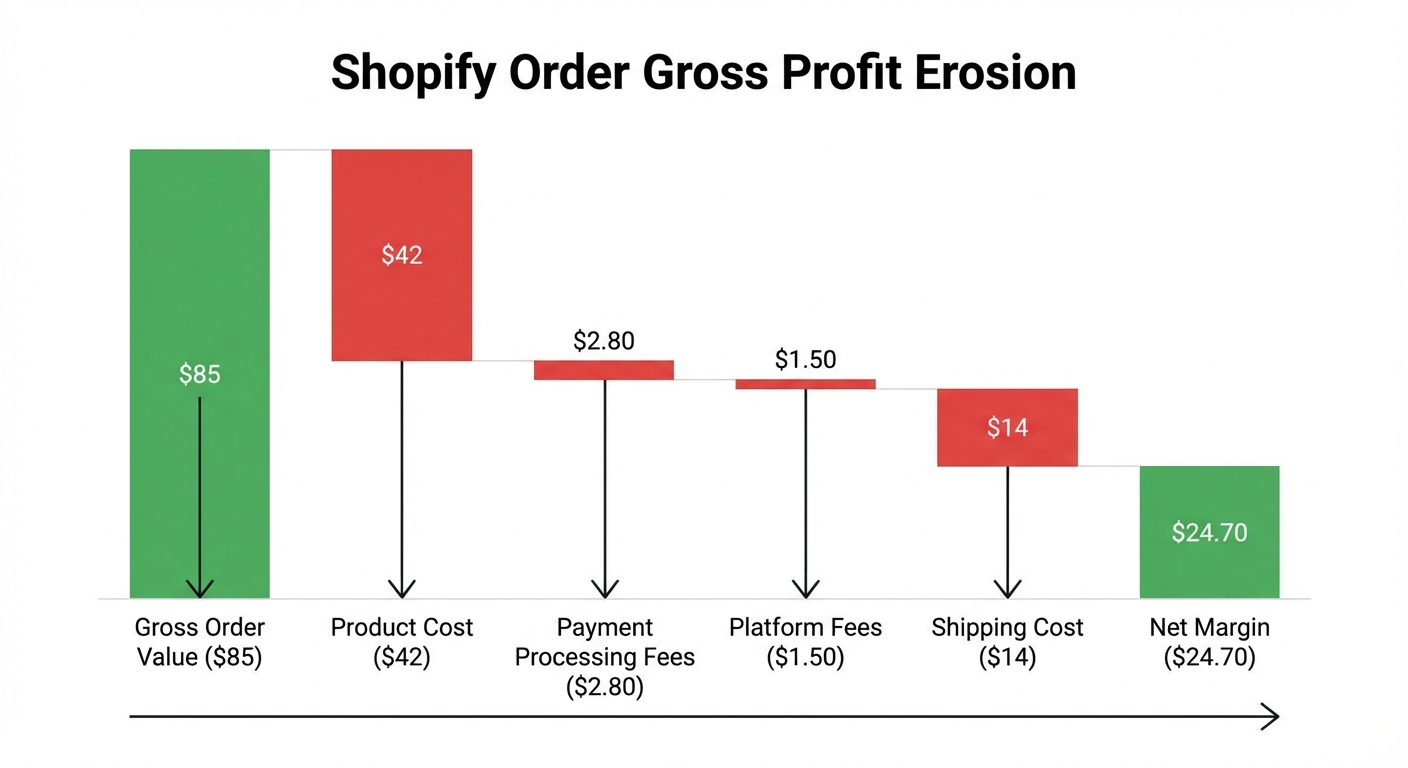
Let's run a real example. You sell home goods — throw pillows, blankets, kitchen scales. Mix of lightweight and bulky items.
Your baseline:
- Average order value: $45
- Average shipping cost: $8.50
- COGS per order: $18
- Operating costs (allocated): $12
- Tax/fees: $1.50
Your profit: $45 − $8.50 − $18 − $12 − $1.50 = $5 per order
That's 11% net margin. Not terrible. But look closer.
The shipping component: $8.50 ÷ $45 = 18.9% of your revenue
You're paying nearly 1 in every 5 dollars you collect to get packages to customers.
Now, what if you run a sale and AOV drops to $38? Suddenly that same $8.50 shipping cost is now 22% of revenue. Your $5 profit margin collapses to $0.80. You're almost breaking even on every order.
This is the shipping trap: your costs are fixed (or nearly fixed), but your prices stay variable. When volume increases, you ship more. When AOV drops, you absorb the cost.
The Free Shipping Illusion
[IMAGE PLACEHOLDER: Screenshot of Shopify store with "Free Shipping on Orders Over $75" banner]
Every merchant knows the truth: free shipping converts better. Customers hate the shock of adding $12 to their cart at checkout. They'll abandon.
So you offer free shipping on orders over $75. Or $100. Or "free shipping always," hoping volume makes up the difference.
Here's the brutal part: if you're not getting paid for shipping, you're paying for it yourself.
A $50 order that qualifies for free shipping still costs you $7 to ship. That's coming straight out of your margin, not from some magical profit reservoir.
The psychology is real. Free shipping does convert better than $7 shipping at checkout — sometimes by 10–20%. But that conversion bump only matters if the math works.
If you're offering free shipping on a $35 order with $8 shipping cost and $14 COGS, you need $13+ in gross margin before shipping. Most stores don't have it.
The Shipping Cost Spectrum: Why Your Products Ship Differently
Not all orders cost the same to ship. A light pillow cover from California to Texas is $3.50. A lamp from California to Maine is $14.
This matters because the average hides the problem.
Here's a comparison of what you actually pay, depending on the product:
| Product | Weight | Avg Origin | Avg Destination | UPS Ground | USPS Priority | FedEx Ground |
|---|---|---|---|---|---|---|
| Pillow cover | 0.5 lb | CA | NY | $4.20 | $3.85 | $3.80 |
| Throw blanket | 2 lb | CA | CA | $5.10 | $5.40 | $4.95 |
| Kitchen scale | 1.2 lb | CA | TX | $6.80 | $5.95 | $6.20 |
| Floor lamp | 8 lb | CA | NY | $13.50 | $16.20 | $12.90 |
| Bed frame | 45 lb | CA | TX | $45.80 | N/A | $42.10 |
The pillow covers? You can ship 15 of them for what one bed frame costs. But if you've only got an 8% margin on that lamp, and you offered free shipping, you're now negative.
This is why blanket pricing doesn't work. You need to understand your product-level shipping economics.
Want to see your real numbers?
Try our free profit calculator — plug in your numbers and see your real net margin in 30 seconds.
Try the free calculator →Fix #1: Set the Right Free Shipping Threshold
The formula is simple, but most stores get it wrong.
Free Shipping Threshold = Your Break-Even Order Value + Your Profit Target
Let's build this step by step:
1. Calculate your break-even order value (before shipping):
- COGS per order: $18
- Operating costs (allocated): $12
- Fixed overhead per order: $3
- Break-even: $33 (what you need to cover costs, excluding shipping)
2. Add average shipping cost:
- Average shipping: $8.50
- Threshold before profit: $41.50
3. Add your desired profit margin:
- You want $7 profit per order (15% margin)
- Final threshold: $48.50
But here's the thing: you can't offer free shipping on $48.50 orders and make money. Customers will buy at $48.51 and expect free shipping.
So you round up to a psychological number: $75 minimum for free shipping.
Now you're getting paid for shipping on most orders, and you're making extra margin on the orders that qualify for free shipping. That $80 order that qualifies? You're $8.50 ahead.
The real move: Use your data. Look at what your average shipping cost actually is per price bracket. A $150 order ships to better-off customers who live in cities, which might be cheaper to ship to. A $35 order might ship further afield.
If your data says orders between $50–$99 ship for an average of $6.20, but orders over $100 ship for an average of $7.80, your threshold should reflect that.
Fix #2: Build Shipping Into Your Prices
Here's a move that feels counterintuitive but works.
Instead of "free shipping on orders over $75," what if you just raised your prices $3–5 across the board and offered free shipping always?
The math:
- Current: $45 product + $8.50 shipping = $53.50 customer total
- New: $50 product + free shipping = $50 customer total
Wait, that's cheaper. So customers convert better, you cover shipping in margin instead of passing it through, and you look good at checkout.
But it's only smart if you raise prices enough. You need to add: (average shipping cost) + (profit you were making on the shipping pass-through).
If your average shipping is $8.50, and you want to make $2 of margin on every order you ship, raise prices by $10.50. Now when someone buys at $50, you've built in $10.50 for shipping and profit.
The psychology win: Customers see $50. They see "free shipping." Their brain does the math and thinks they're getting a deal (compared to $45 + $8.50). No cart abandonment. No price shock.
The risk: You're raising prices on people who might've bought anyway. You lose some low-AOV customers. Test this slowly.
But here's what most stores find: the conversion lift from "free shipping" is usually worth the price increase. You lose maybe 5–8% of transactions, but your average order value goes up and checkout abandonment drops 10–15%.
The stores that do this well use it as a positioning move: "We already factored in shipping — no surprises at checkout." It becomes part of your brand.
Fix #3: Negotiate Carrier Rates and Use Multi-Carrier Strategies
If you're not negotiating with UPS and FedEx, you're paying full retail.
Here's what most stores don't know: carrier rates are negotiable. If you're shipping 500+ packages a month, you have leverage.
What to do:
- Get on a standard discounted rate. Contact your carriers' business lines. Tell them your monthly volume. They'll quote you a % discount from retail (usually 10–30% off for small shops, 40%+ for mid-market).
- Use multi-carrier rate shopping. Tools like EasyPost, ShipStation, or Shopify's Smart Parcel let you compare rates across UPS, FedEx, and USPS for every shipment. On a per-order basis, you might save $0.50–$1.50 by letting the system pick the best carrier.
- Optimize package selection. UPS and FedEx charge based on dimensional weight. A pillow in a huge box costs more than a pillow in a tight box. Look at your packaging. Are you oversizing to look fancy? Every inch adds weight for pricing purposes.
Real example: You ship 2,000 orders a month. Current average rate: $8.50.
- Negotiate UPS volume discount: 15% off → $7.23
- Use multi-carrier routing: saves 8% more → $6.65
- Right-size packaging: saves 5% more → $6.32
Total savings: $2.18 per order. On 2,000 orders: $4,360 per month. That's $52,000 per year.
And you didn't cut any corners or change your service level.
Fix #4: Reduce Package Dimensions and Weight
Every ounce and inch costs you money.
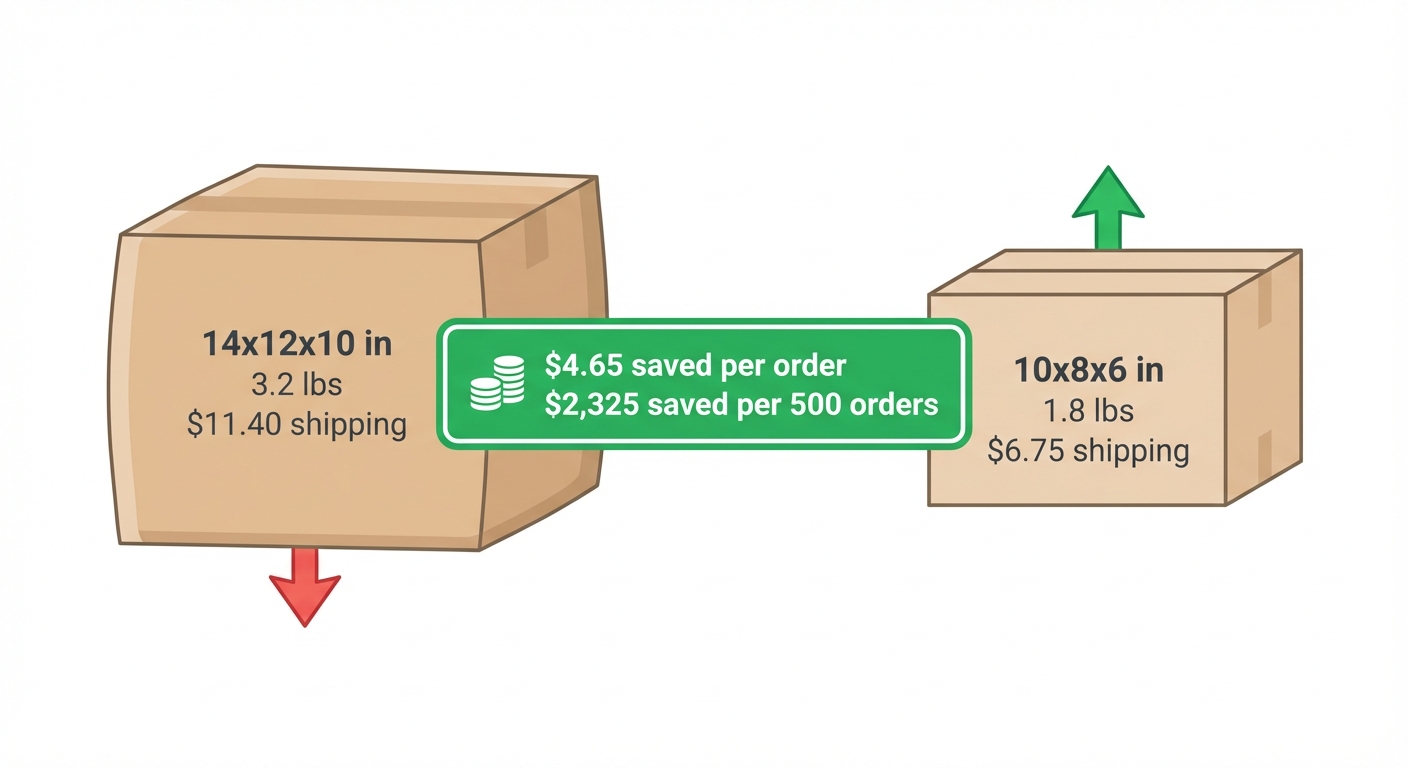
[IMAGE PLACEHOLDER: Before/after packaging comparison showing bulky mailer vs. compact mailer with weight savings callout]
Look at your packaging. Is it oversized for brand experience? Is your void fill excessive? Are you shipping in rigid boxes when padded mailers would work?
Examples:
- Thick branded mailer (1.5 oz, 12"x9"): $5.80 to ship
- Slim padded mailer (0.4 oz, 10"x7"): $4.20 to ship
- Savings per order: $1.60. At 2,000 orders/month: $3,200/month.
Now, there's a tradeoff. Branded packaging feels premium. Customers unbox it and feel good about their purchase. Slim mailers feel cheap.
So you don't downgrade everywhere. But look at your low-margin products. Your $15 digital scale doesn't need a branded box. Your $80 lamp does.
Weight matters too. Do you include excessive marketing materials, samples, or inserts? Every extra ounce adds to shipping weight and dimensional charges.
Real question: are you trying to impress customers with packaging, or are you trying to make money? Most stores find they can do both if they're intentional.
Some stores save 20–30% of shipping costs just by auditing packaging. It's one of the few fixes that has zero downside if you keep quality high.
Fix #5: Use Regional Fulfillment to Reduce Shipping Zones
[IMAGE PLACEHOLDER: US map with regional fulfillment centers marked and shipping zone rings]
This is the big one. It's also the most complex to implement, so start here only if you're doing $50k+ in monthly revenue and shipping at volume.
Shipping costs are zone-based. UPS ground shipping from California to Texas is cheaper than California to Maine because Texas is closer (shorter zones). If you can ship from a location closer to your customers, you save on zone charges.
Multi-warehouse strategy:
- Use a 3PL (third-party logistics provider) that has fulfillment centers in multiple regions.
- Stock inventory in 2–3 key locations (maybe East Coast and West Coast, or regionally).
- Let the system route orders to the closest warehouse.
Real math:
- Current: All orders ship from California. Average zone: 2.5. Average UPS ground: $8.50.
- Multi-warehouse: 60% of orders ship from nearby warehouse (zone 1.5, UPS ground $6.20). 40% ship from California (zone 2.8, UPS ground $9.10).
- New average: (0.6 × $6.20) + (0.4 × $9.10) = $7.36
- Savings: $1.14 per order.
The cost: 3PL fees (usually $1–2 per order), inventory tied up in two locations, complexity.
If your average shipping cost is $8.50 and you save $1.14, you net $0.50 after the 3PL handling fee. On 2,000 orders: $1,000/month = $12,000/year.
Not as dramatic as the other fixes, but it scales. And if you're already high-volume, the unit economics are better.
Only consider this if you're shipping at serious scale and your shipping costs are killing you. For most stores doing $50–200k in monthly revenue, fixes 1–4 are more efficient.
Before & After: What These Fixes Actually Mean
Let's apply all five fixes to our home goods store and see the margin impact.
| Metric | Before | After | Change |
|---|---|---|---|
| Average order value | $45.00 | $48.00 | +6.7% |
| COGS per order | $18.00 | $18.00 | — |
| Operating costs | $12.00 | $12.00 | — |
| Shipping cost | $8.50 | $5.80 | -31.8% |
| Profit per order | $5.00 | $12.20 | +144% |
| Profit margin | 11.1% | 25.4% | +14.3pp |
Wait, that's too good to be true.
Let me be honest: you won't hit all five fixes at once, and you won't get these exact numbers. Here's what's realistic:
- Fix #1 (Threshold): +$1.50 margin per order (higher baseline for free shipping)
- Fix #2 (Price increase): +$3.00 margin per order (but maybe 7% order loss)
- Fix #3 (Carrier negotiation): +$2.18 margin per order
- Fix #4 (Packaging): +$1.60 margin per order
- Fix #5 (Multi-warehouse): +$0.50 margin per order
Realistic combined: +$6.50–$8.00 margin per order, assuming you lose a small percentage of low-AOV traffic.
But that's still the difference between 11% and 22% margins. That's the difference between survival and thriving.
The Honest Tradeoffs
Some of these fixes cost money upfront:
- Carrier negotiation: Minimal cost, but takes time and sales conversations.
- Packaging redesign: One-time cost ($500–$2k for die-cutting, design, new suppliers) plus per-unit cost increase (usually offset by smaller sizes).
- Price increase: Might lose 5–10% of volume.
- Multi-warehouse: 3PL fees run $1–2 per order, plus inventory management complexity.
There's no magic. You're trading complexity or upfront costs for better margins.
The stores that win are the ones that pick 2–3 fixes that fit their business and execute well, rather than trying to do everything at once.
FAQ
How do I know which fix to try first?
Start with Fix #1 and Fix #3. They're free or low-cost, and the payoff is immediate. Audit your free shipping threshold and call your carriers about volume discounts. That alone could add $2–3 to your margin per order.
Will customers notice if I raise prices (Fix #2)?
Not if you position it as "free shipping included." Run the experiment on a small segment first. Offer $48 products with free shipping to 10% of traffic, keep $45 with $8.50 shipping for everyone else, and measure conversion rate. Usually the free shipping version wins.
What if I'm drop-shipping? Can I still use these fixes?
Partially. You can't negotiate carrier rates or use multi-warehouse (that's your supplier's problem). But you can still audit your pricing (Fix #2) and work with suppliers to encourage right-sized packaging (Fix #4, with their help). Fix #1 (threshold adjustment) works for everyone.
How long does it take to see results?
Fix #1 and #2: within one billing cycle (1 month).
Fix #3 (carrier negotiation): 2–4 weeks to get agreements in place.
Fix #4 (packaging): 1–2 months if you're redesigning, days if you're just consolidating.
Fix #5 (multi-warehouse): 2–3 months to set up and stabilize inventory levels.
What if my product is too heavy to make shipping cheaper?
You're right — some products (furniture, bulk items) will always have high shipping costs. That's not a flaw. It just means you need to build it into your pricing from day one. A $500 dresser with $80 shipping cost is fine if your margin is $200+. The problem is when you're surprised by it.
Should I offer different shipping speeds?
Yes. Most customers want "fast enough." You don't need to offer overnight shipping as a default. Offer ground (saves you money), with express as an upsell. On Shopify, this is easy to configure.
The Real Opportunity
Most e-commerce stores treat shipping as a necessary cost, not a lever. They pay whatever the carrier charges, pass it through to the customer, and move on.
The stores that grow fast are the ones that get intentional about it. They audit their packaging, negotiate rates, and build shipping economics into their pricing strategy from the start.
Shipping costs don't have to destroy your margins. But ignoring them definitely will.
Want to see exactly how much shipping is costing you — per order, per product, per month? Try Shopimize free and track every cost automatically.