
Do You Lose Money on Shopify Refunds? (Yes, and Here's How Much)
You just got a refund request. Your stomach drops a little. You hit "refund" and think you're done. But here's the part nobody tells you: you just lost way more than the sale price.
When a customer asks for their money back, Shopify processes the refund. Your bank account shows the customer got their money. Feels fair, right? But it's not. You're leaving money on the table—sometimes $10, $15, even $20+ per refund—and you probably don't realize it.
I'm going to walk you through exactly what happens when you refund an order, break down the five hidden costs nobody talks about, and show you the math on how much this is actually costing your business every year. Then we'll talk about how to fix it.
The Five Hidden Costs of Every Shopify Refund
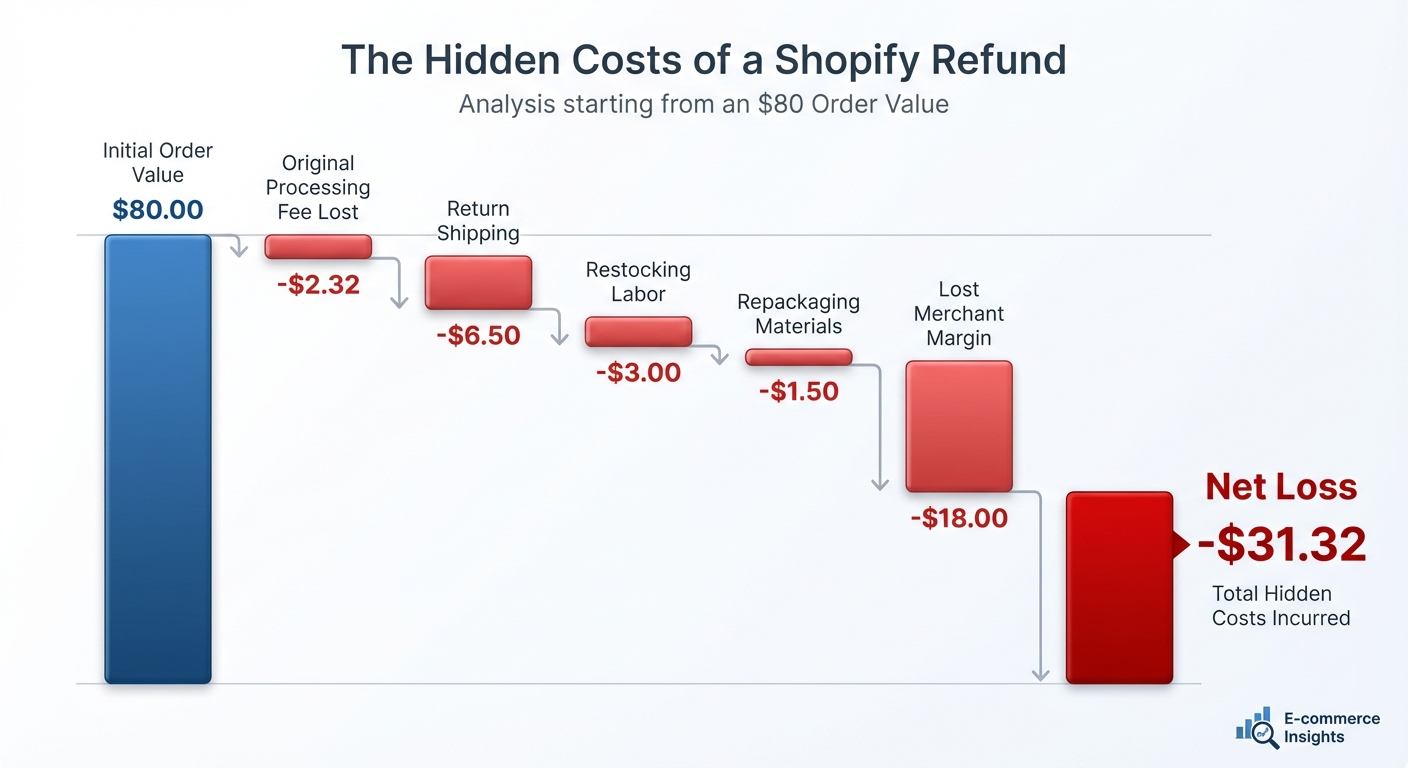
When you process a refund, you're not just giving back the sale price. Here's what actually happens:
1. Non-Refundable Payment Processing Fees (2.9% + 30¢ Gone Forever)
This is the big one. Shopify Payments charges you 2.9% + 30¢ per transaction. When your customer buys something for $50, that fee comes out of your payment processing. You paid $1.75 to process that order.
Here's the problem: Shopify doesn't refund the payment processing fee.
Let's say your customer returns that $50 item. You refund the $50. But Shopify keeps the $1.75. Gone. You've now lost $51.75 on this order—the full refund amount plus the fee you already paid to accept the original payment.
This might seem small per order. But it's not. On a $300K/year store, if you're processing 6,000 orders annually, your average payment fee is around $1,600. If 12% of those orders get refunded (we'll talk about that number), that's 720 refunds. At an average $42 per refund, that's $1,260 in non-refundable fees alone.
2. Original Shipping Cost (Free Shipping That Doesn't Come Back)
Free shipping is a conversion booster. It works. Customers love it. But when they return the item, you don't get the shipping cost back.
Most e-commerce stores offer free shipping over a certain threshold or as part of their brand promise. You ate $5–10 (sometimes more) to get that order to the customer. When they send it back, you lose that cost completely.
If you charged for shipping, you might refund the shipping cost to the customer—which is fair. But either way, you're out the money.
On a $50 order with $8 free shipping, you've now lost $59 total.
3. Return Shipping Cost (If You Provide Return Labels)
Smart Shopify stores provide prepaid return labels. It's a best practice. It increases refund rates (customers are more likely to return something if it's easy), but it also increases return shipping costs you have to cover.
Return shipping isn't cheap. Ground shipping for a typical package costs $5–15. Expedited return options cost even more. If you offer multiple return shipping speeds, you're eating the cost of whichever option the customer chooses.
Some stores ask customers to pay for return shipping. Those stores have lower conversion rates. So most of you are paying.
That's another $5–10 per return. On a $50 refund, you're now at $64–69 total cost.
4. Restocking and Handling Labor ($2–5 Per Return)
Someone has to process that return. It shows up at your warehouse or your mailbox. You (or someone you pay) has to:
- Receive the package
- Inspect the item
- Check it against the return reason
- Update your inventory system
- Decide if it's resellable
- Put it back on the shelf or decide what to do with it
Even if you're doing this yourself, your time has value. At $15–20/hour, each return takes 10–15 minutes to process. That's $2.50–5 per return in direct labor.
If you're using a 3PL (third-party logistics provider) or return management service, they'll charge you $2–8 per return.
Either way, that's another $2–5 per refund.
5. Product Condition Loss (10–30% Resale Value Lost)
Here's the worst part: most returned items can't be resold at full price.
Sure, the item was "gently used" or "just tried on." But you didn't make the sale. You can't charge full price. Here's what happens to most returned items:
- They go into clearance bin (20–30% off)
- They get damaged in shipping and need to be marked down further
- They sit in inventory longer, tying up cash
- Some items can't be resold at all (opened beauty products, tried-on shoes, customized items)
Even if the return was legit and you get the item back in perfect condition, you're looking at a 10–30% loss in resale value compared to selling it new at full price.
On a $50 item you can now only sell for $35–40, you've lost another $10–15 in margin.
The Real Math: What a Refund Actually Costs
Let's walk through a real example.
Scenario: A customer orders a $50 item with free $8 shipping. They return it after 5 days.
Here's what you lose:
| Cost | Amount |
|---|---|
| Refund amount | $50.00 |
| Non-refundable payment processing fee (2.9% + 30¢) | $1.75 |
| Original shipping cost (free shipping you offered) | $8.00 |
| Return shipping label (prepaid ground) | $7.50 |
| Labor to process the return (15 min @ $20/hr) | $5.00 |
| Product condition loss (selling at 75% of original price) | $12.50 |
| Total Cost to You | $84.75 |
You lost $84.75. The sale price was $50.
That return actually cost you $84.75 in real money and lost profit—69% more than the original sale price.
The Annual Impact: It Adds Up Fast
Most stores don't think about this on a per-refund basis. They should, because the annual math is terrifying.
Let's say your store does $300K in annual revenue:
- Average order value: $50
- Total orders per year: 6,000
- Return rate: 12% (we'll explain this varies by industry)
- Average refund cost per return: $16 (payment fees + shipping + labor + condition loss)
Total annual hidden cost of refunds: $11,520
That's $11,520 a year that's leaving your business through refunds, on top of the lost gross profit from those $360K worth of returned items.
If your profit margin is 20%, the lost margin alone is $72,000. Add in the $11,520 in hard refund costs, and your return rate is actually costing you $83,520 per year.
Even small changes to return rates move the needle.
A 1% reduction in return rate (from 12% to 11%) saves you roughly $7K/year on a $300K store. A 2% reduction saves $14K/year. For many store owners, that's the difference between breaking even and being profitable.
Return Rates by Industry (What's Normal for You?)
Return rates vary wildly by product category. Here's what to expect:
| Category | Typical Return Rate | Why |
|---|---|---|
| Apparel & Fashion | 20–35% | Size/fit issues, fast fashion expectations |
| Shoes | 25–40% | Fit is critical, customers order multiple sizes |
| Electronics | 12–20% | Quality expectations, compatibility issues |
| Beauty & Skincare | 5–12% | Lower return rate, but higher per-unit loss |
| Home & Furniture | 10–18% | Damage in shipping, fit concerns |
| Accessories | 8–15% | Lower value, more experimental purchases |
| Sports & Outdoors | 10–20% | Product performance expectations |
If you're in apparel, 25% returns might be normal. You need a different strategy than a beauty store with 8% returns.
[IMAGE PLACEHOLDER: Chart showing return rates by category]
Want to see your real numbers?
Try our free profit calculator — plug in your numbers and see your real net margin in 30 seconds.
Try the free calculator →How to Actually Reduce Return Rates (And Protect Your Margins)
Knowing what's costing you money is step one. Step two is fixing it.
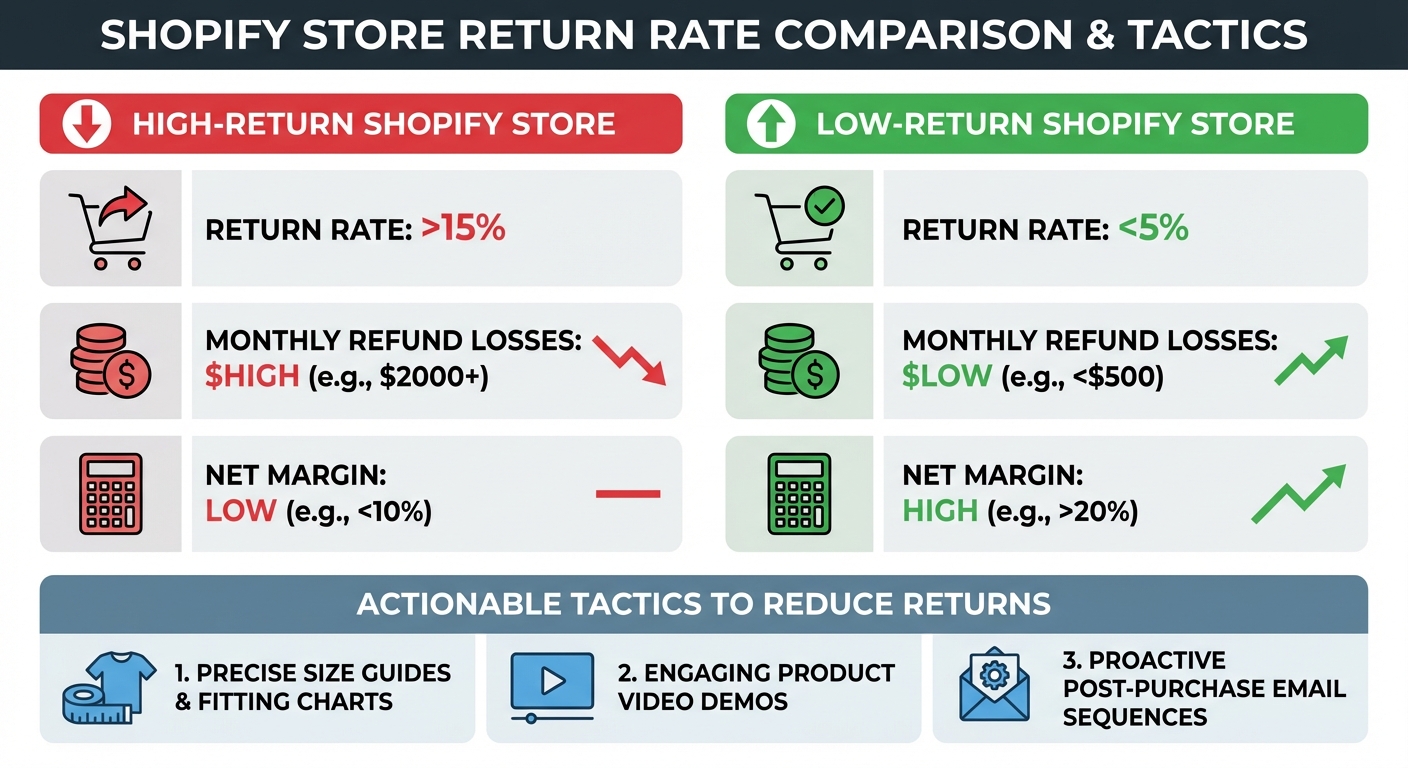
1. Better Product Descriptions (Reduce Fit/Expectation Mismatches)
The #1 reason for returns? Customers got something different than what they expected. Blurry photos. Missing dimensions. No size chart. No fabric content.
Invest in:
- Detailed measurements — "Chest: 38″, Length: 28″, Sleeve: 32″" (not just S/M/L)
- Multiple angles — Show seams, zippers, hems, pockets
- Real fabric/material info — "100% organic cotton, pre-shrunk" instead of just "cotton"
- Lifestyle photos — Show how it actually looks on different body types
- Video — 30-second product video cuts returns by 10–20% on apparel
This costs time upfront but pays dividends in lower returns.
2. Size Guides and Fit Tools
Apparel stores can reduce returns 15–25% with better size guidance:
- Measurement charts tied to brand-specific sizing (most brands fit differently)
- Size comparison tools that let customers compare to items they own
- Video fit guides — "This runs small, size up one size"
- Customer reviews with size notes — "I'm 5'6", usually wear Medium, sized up to Large and it's perfect"
- AI fit prediction (if your budget allows) — Some platforms like Size.com predict fit based on customer measurements
Shopify apps like "Fitty" and "Sizeer" automate this.
3. Exchange-First Policy Instead of Refund-First
Here's a strategy that works: Offer exchanges before refunds.
Instead of "We accept returns for 30 days," try: "We accept exchanges for 30 days. Full refunds available after 30 days or if exchange isn't available."
Why? An exchange keeps the revenue, removes only the fulfillment cost, and keeps the customer. A refund loses everything.
Shopify doesn't natively support "offer exchange first," but you can handle this through customer communication. When someone requests a return, your response can be:
"Thanks for reaching out! Can we send you a different size/color instead? That way you'll get exactly what you want without any delay."
You'd be surprised how many customers accept. And those who don't still feel the brand cares.
4. Restocking Fees (Be Strategic)
Some stores charge restocking fees ($5–15 per return). This works for some audiences and backfires for others.
When restocking fees work:
- B2B or wholesale businesses (expected)
- Electronics and high-value items (customers expect it)
- Clearance/final sale items
When restocking fees hurt:
- Fashion and apparel (kills conversion rates and reviews)
- Luxury brands (signal of lower quality)
- New stores with low trust
If you do charge restocking fees, be transparent. Include it on your shipping page and in your return policy.
5. Free Shipping Threshold (Don't Offer It Below a Certain Order Value)
Free shipping is powerful. But every free shipping offer costs you money on returns. If you offer free shipping on all orders over $30, you eat that cost on every $30–50 refund.
Consider:
- Higher threshold: "Free shipping on orders over $100" instead of $50
- Free returns only for free shipping orders: "You qualify for free return shipping on this order because you got free shipping"
- Tiered model: "Free shipping over $50, OR $5 flat rate"
This reduces the shipping cost hit on lower-value returns.
6. Smart Return Window (Shorter Is Better, If You Can Do It)
Default 30-day return window? Most stores offer that. But shorter windows reduce returns:
- 30 days vs 14 days = 10–15% fewer returns (customers who wait longer are less likely to return)
- 7 days vs 30 days = 25–35% fewer returns (but will hurt conversion on new stores)
The risk: a shorter window can hurt conversion, especially if you have low brand trust. A longer window increases returns but increases customer confidence at purchase.
Most stores find 21 days is the sweet spot.
The Bottom Line: You're Losing More Than You Think
When you process a refund, you're not just losing a sale. You're losing:
- Payment processing fees you already paid
- Shipping costs you already ate
- Return logistics
- Labor
- Product resale value
On a typical $50 refund, you're out $12–18 in hard costs, plus the lost margin on the sale. Scale that across 500–1,000 annual returns, and you're bleeding thousands of dollars.
The good news? This is fixable. Better descriptions, size guides, exchange-first policies, and smarter return windows can cut your return rate by 5–10%. On a $300K store, that's $7,000–$14,000 a year back in your pocket.
FAQ: Common Questions About Shopify Refund Costs
Q: Does Shopify refund my payment processing fees?
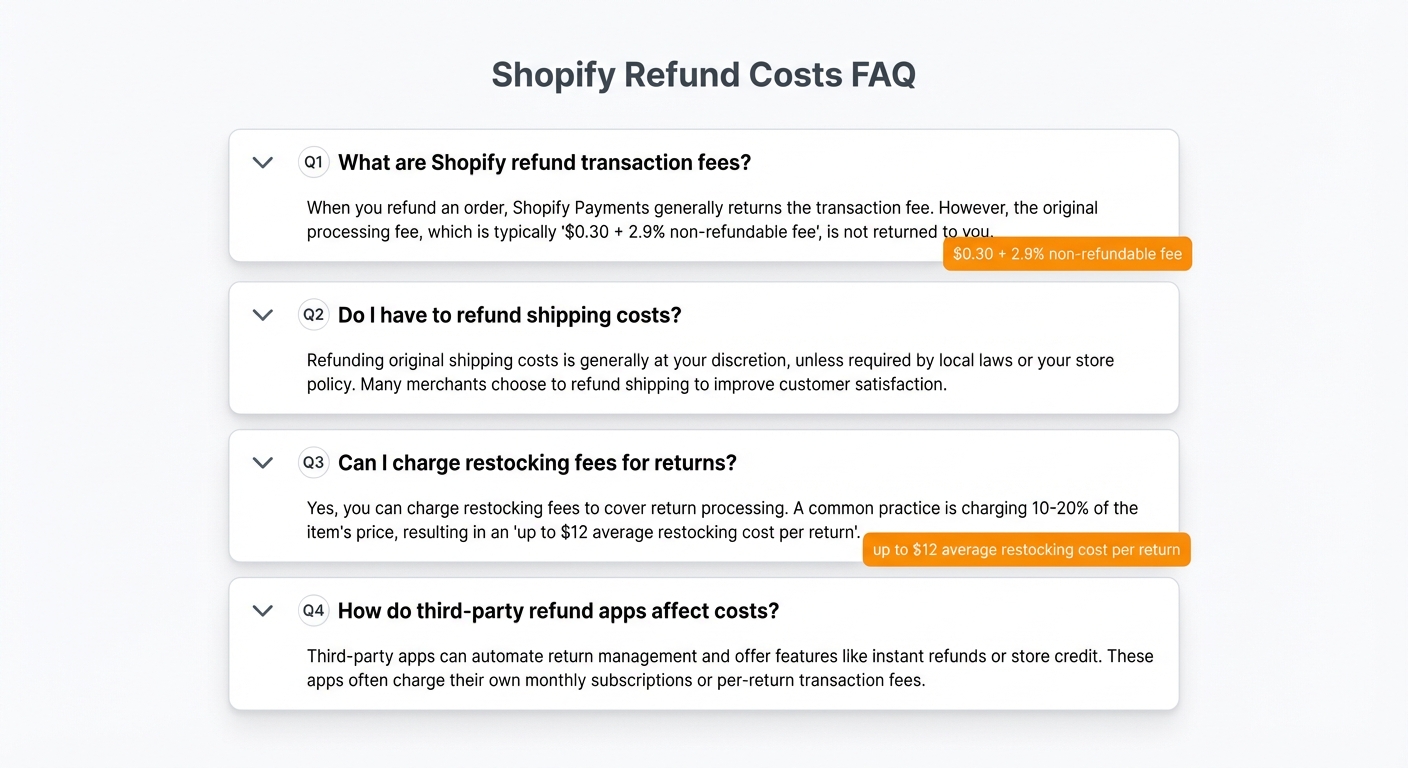
A: No. If you use Shopify Payments, the credit card processing fee (2.9% + 30¢) is non-refundable. When you refund an order, Shopify refunds the customer's money, but you don't get back the fee you paid to process the original sale.
Q: Can I charge a restocking fee to cover these costs?
A: Yes, but be careful. A 10–15% restocking fee is reasonable and expected in some industries (electronics, furniture, beauty). It'll hurt conversion in others (apparel, fashion). Test it with your audience and be transparent in your return policy.
Q: What's a "normal" return rate?
A: It varies by category. Apparel: 20–35%. Electronics: 12–20%. Beauty: 5–12%. If your return rate is significantly higher than your category average, you likely have a product description or quality issue worth investigating.
Q: How do I reduce return rates?
A: In order of impact: (1) Better product descriptions and photos, (2) Size guides and fit tools, (3) Exchange-first policy, (4) Shorter return window, (5) Restocking fees if your audience accepts them.
Q: Does offering free returns increase return rates?
A: Yes, typically by 10–20%. Free return shipping removes the friction barrier, so customers are more likely to return. This costs you money but can increase conversion on new sites. It's a tradeoff.
Want to See the Real Cost of Your Returns?
Your store's return costs are unique. A 12% return rate on apparel hits differently than a 12% return rate on beauty. Your shipping costs might be $8, or they might be $12. Your profit margins might be 15%, or they might be 30%.
The only way to know what you're actually losing is to look at your own data.
That's what Shopimize does. We show you exactly where the money's going—including the hidden costs nobody talks about. Returns, shipping, fees, product costs. All of it.
Want to see exactly how much refunds cost your store — automatically? Try Shopimize free and track the true cost of every return. No credit card required, and you'll see results in minutes.
Your margins are hiding in the details. Let's find them together.