
TikTok Ads Profitability: Is Your Viral Traffic Actually Making Money?
You've seen it happen. A TikTok ad goes viral. You get 50,000 views, thousands of clicks, and your shopify notifications blow up. Your cost per click is $0.30. Your cost per mille (CPM) is $7. Both numbers look incredible compared to Facebook or Google.
Then you check your profit margin the next day.
And it's gone.
This is the TikTok ads paradox. The platform can drive stunning traffic and revenue numbers—but that doesn't mean you're actually making money. Viral doesn't equal profitable.
In this article, we're going to walk through the real math. We'll compare TikTok metrics head-to-head with other channels. We'll show you why cheaper clicks often lead to fatter losses. And we'll give you five concrete strategies to make TikTok ads actually work for your bottom line.
[IMAGE PLACEHOLDER: A graph showing viral traffic spike with downward profitability arrow]
The TikTok Ads Math Problem
Let's start with what makes TikTok so appealing to e-commerce sellers.
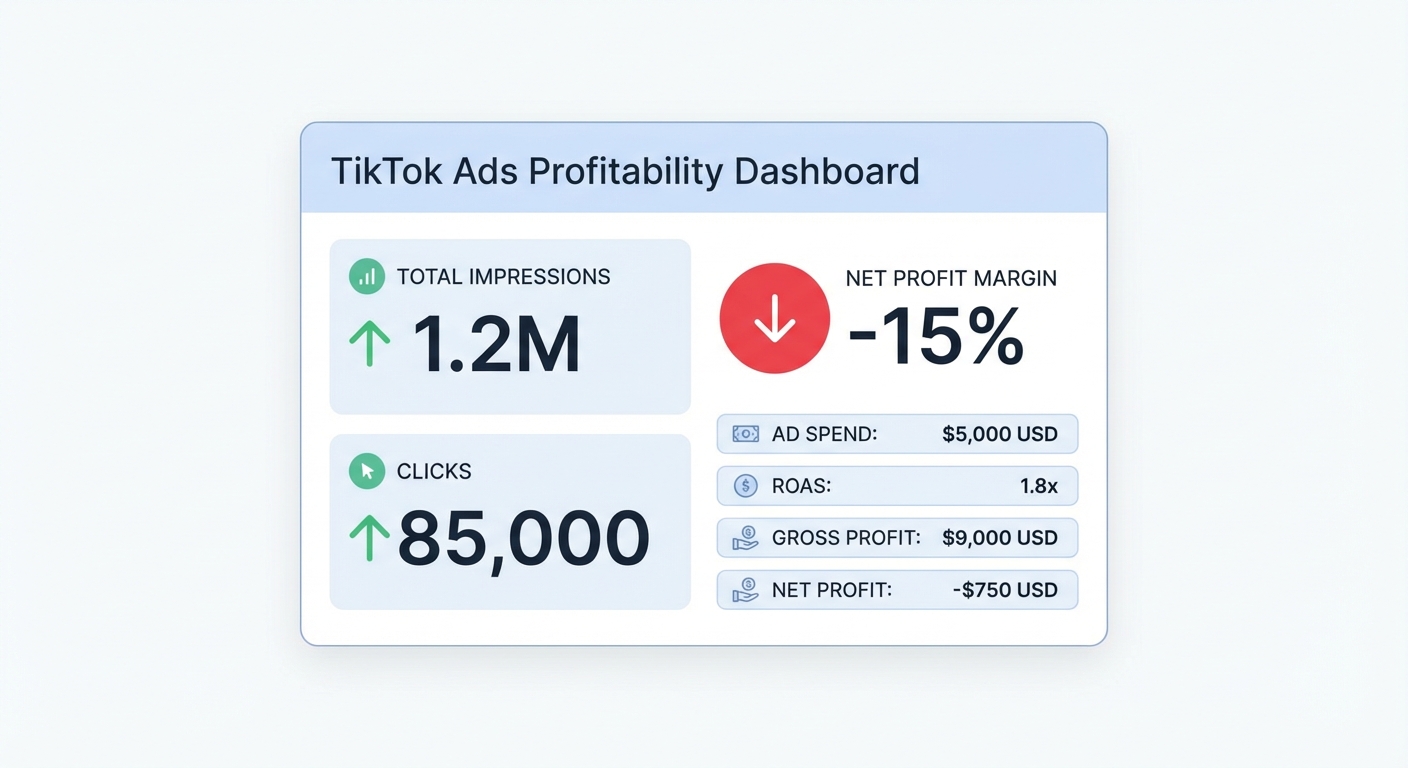
The numbers look great:
- CPM of $6–12 (vs. $10–18 on Facebook)
- Cost per click around $0.25–0.50
- Ability to reach millions of users in days
The temptation is real. You can spend $3,000 and reach half a million people. What's not to love?
Here's the problem: cheaper clicks don't always mean better profits.
In fact, we've seen the opposite happen hundreds of times. Store owners spend $5,000 on TikTok, drive 20,000 visitors, and lose money on the campaign despite strong top-line sales numbers.
Why? The economics of TikTok traffic are fundamentally different from search, Google Shopping, or even Facebook.
TikTok vs. Other Channels: The Real Numbers
Let's compare average metrics across platforms:
| Metric | TikTok | Google Ads (Search) | ||
|---|---|---|---|---|
| Typical CPM | $6–12 | $10–18 | N/A (CPC model) | $8–15 |
| Typical CPC | $0.25–0.50 | $0.40–1.00 | $1–2 | $0.30–0.75 |
| Click-Through Rate | 1–2% | 1.5–2.5% | 2–4% | 2–3% |
| Conversion Rate | 1–3% | 2–4% | 3–6% | 2–4% |
| Average Order Value | $30–50 | $45–75 | $60–100+ | $35–60 |
| Return Rate | 20–30% | 10–15% | 8–12% | 10–18% |
What this table shows us:
TikTok wins on cost per click. Hands down. Advertisers love that. But notice the columns on the right: conversion rates are lower, order values tend to be smaller, and return rates are significantly higher.
That combination creates a margin problem fast.
The Impulse Buy Problem
Here's the core issue: TikTok drives impulse purchases.
That's not a criticism. It's just how the platform works. Users are scrolling, entertained, not in a shopping mindset. They see your product, think "huh, that's cool," and click. The friction is low. The intent is fuzzy.
This leads to three margin killers:
1. Lower Average Order Value
On TikTok, you're typically selling to browsers, not searchers. Someone using Google Shopping is actively looking for your product category. Someone on TikTok discovered you by accident. That difference shows up in AOV—often 30–40% lower than search or targeted Facebook campaigns.
2. Higher Return Rates
When customers impulse-buy, they impulse-return. We've seen TikTok traffic with 25–30% return rates—double what you'd see from search traffic. Returns destroy profitability faster than almost anything else because you absorb shipping, restocking, and lost inventory turnover.
3. Lower Repeat Purchase Rates
TikTok buyers are less likely to become repeat customers than search or Facebook buyers. They bought on impulse. They may not even remember your brand next week. This matters because repeat purchases are where real profitability lives in e-commerce.
Track this automatically
Shopimize shows your real profit per order, per product, per channel.
Try Shopimize free →The Attribution Problem
Here's another problem most sellers miss: TikTok's attribution window is aggressive.
TikTok offers:
- 7-day click window (conversions up to 7 days after a click)
- 1-day view window (conversions up to 1 day after a view, without a click)
Compare that to:
- Facebook: 7-day click, 7-day view (with options to extend)
- Google: 30-day click default
- Search: 30-day click default
On the surface, 7-day click looks reasonable. But in practice, TikTok's attribution can be wildly optimistic. Users click, leave, browse around, buy from you three days later—and TikTok claims the credit. Meanwhile, they also might've seen your Facebook ad, clicked a Google result, or found you through email. TikTok reports the sale as its own.
This means your true TikTok ROAS is often 20–40% lower than what the platform reports.
That gap erases profitability fast.
TikTok Shop vs. Website Traffic: Different Economics
One more complexity: TikTok Shop changes the equation.
If you're selling through TikTok Shop (TikTok's native checkout), the economics are different:
- Lower return rates (users see reviews and ratings before buying)
- Slightly higher AOV
- But: TikTok takes 5% commission + payment processing (vs. 2.9% + $0.30 on Shopify)
If you're driving traffic to your own Shopify store, you own the data and customer relationship, but you absorb all the return logistics, support, and margin loss.
Most profitable path? For volume products with low return rates, TikTok Shop. For branded or margin-dependent products, your own store—but expect lower profitability from TikTok traffic because of the attributes we discussed.
Walking Through the Real Numbers: A $3,000 Campaign
Let's build a real example. You spend $3,000 on TikTok ads. Here's what actually happens:
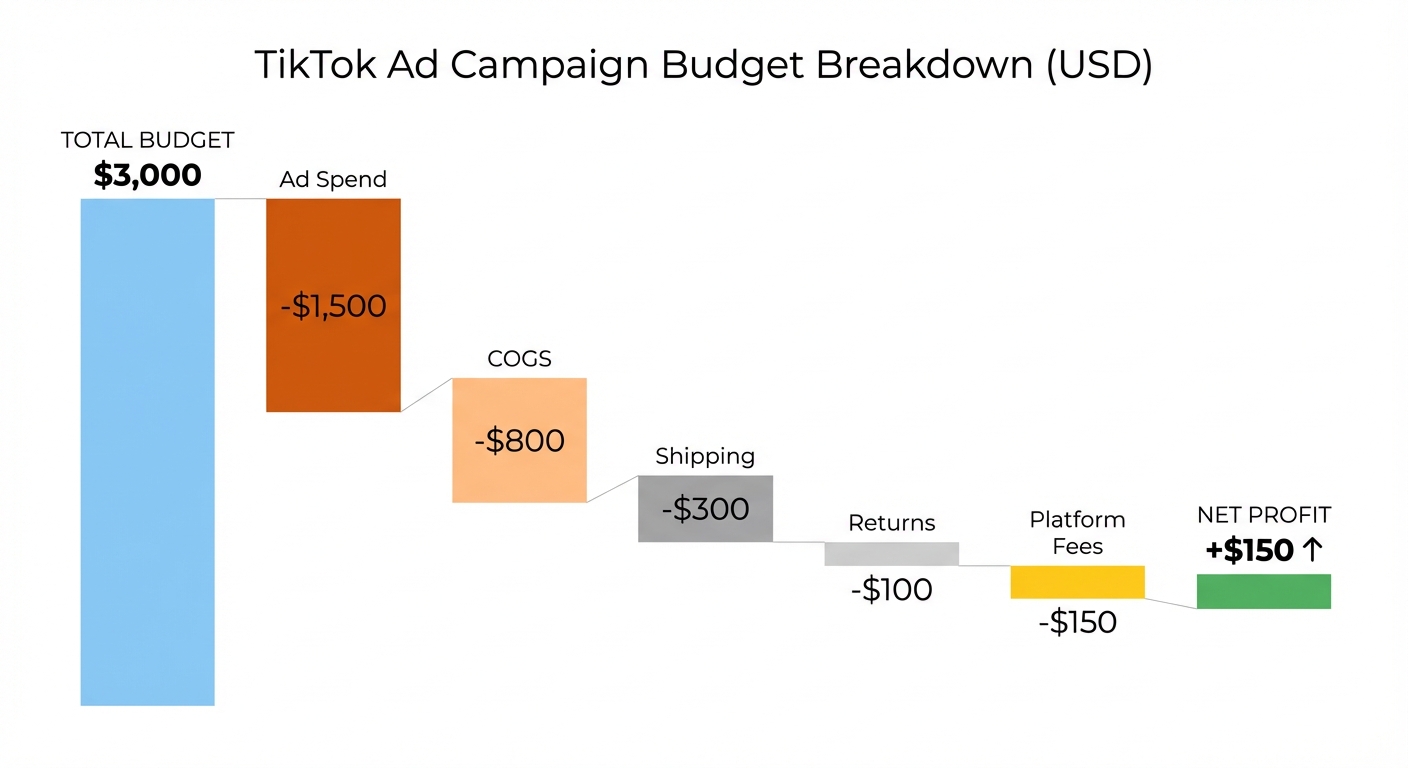
Campaign Metrics:
- Budget: $3,000
- CPM: $8 (average)
- Impressions: 375,000
- CTR: 1.5%
- Clicks: 5,625
- CPC: $0.53
- Conversion rate: 2% (on your website)
- Orders: 112
- Revenue: $4,480 (at $40 AOV)
That looks good, right? $4,480 in revenue on $3,000 spend is a 1.5x ROAS.
But let's add the real numbers:
Cost of Goods Sold (COGS):
- 112 orders × $15 COGS per unit = $1,680
- Gross profit: $4,480 − $1,680 = $2,800
- Gross margin: 62.5%
Returns:
- Return rate on TikTok traffic: 25%
- Returns: 28 units
- Refunded revenue: $1,120
- COGS recovered: $420 (assuming partial loss on restocking)
- Net margin loss: $700
Other Costs:
- Shipping credits/discounts: $225 (2% of revenue)
- Payment processing: $134 (3% of revenue)
- Customer support (refunds, returns): $150
- Ad platform fees (already included in $3K spend)
The Real Profit Calculation:
- Gross profit: $2,800
- Less: Returns margin loss: −$700
- Less: Shipping/discounts: −$225
- Less: Payment processing: −$134
- Less: Support/returns handling: −$150
Net profit: $1,591
Real ROAS: 0.53x (profit ÷ ad spend = $1,591 ÷ $3,000)
You just burned $1,409 in ad spend for net breakeven-ish outcomes. The reported ROAS was 1.5x. Your true profit ROAS was 0.53x.
This is why so many sellers think TikTok ads "don't work"—they're not bad marketers. The economics are just genuinely harder.
[IMAGE PLACEHOLDER: Before/after ROAS comparison showing reported vs. actual profitability]
Five Strategies to Make TikTok Ads Actually Profitable
The good news: TikTok ads can be profitable. They're just not a silver bullet. Here's how to fix the math:
1. **Filter for Lower Return Rate Products**
Not all products work on TikTok. The most profitable ones have these traits:
- Low price point ($15–35, ideally)
- Low return rate (sub-15%, ideally)
- Highly viral appeal (novelty, trend, gift-worthy)
- Impulse-friendly (accessories, beauty, home gadgets vs. apparel, shoes)
If you're selling $100 leather jackets with a 30% return rate, TikTok is probably not your channel. If you're selling $25 fidget toys or phone accessories with a 10% return rate, TikTok could work great.
Action: Audit your product catalog. Segment by product return rate. Only spend on TikTok for your lowest-return categories.
2. **Optimize for Return Rate, Not Just ROAS**
Most sellers optimize for ROAS (return on ad spend). That's a mistake on TikTok. You should optimize for true profit per visitor, which means:
- Lower bids or spend on ad sets with high return rates
- Increase spend on products/audiences with low return rates
- Use TikTok's conversion tracking to tag products and measure returns by ad set
Your goal: 15% return rate or lower from TikTok traffic, not a 2.0x ROAS.
Action: Set up conversion tracking on your Shopify store. Create a custom metric for "true profit per visitor after returns." Bid higher on low-return product sets.
3. **Use TikTok Shop When You Can**
If you're eligible and your product mix supports it, TikTok Shop flattens the return rate problem:
- TikTok Shop has lower return rates (people see reviews)
- Less friction = more impulse buyers
- You trade a 5% commission for lower return logistics
TikTok Shop isn't right for every brand, but for volume, low-return products, the economics often work better than driving external traffic.
Action: Test TikTok Shop with your lowest-return products. Compare cohort profitability vs. website traffic.
4. **Focus on Repeat Purchase Upside**
Because first-purchase profitability on TikTok is so tight, repeat purchases are where you recoup your margin.
TikTok's strength is top-of-funnel volume. Use that to build your email list and past customer base. Then:
- Email nurture sequences (much higher AOV, much lower CAC)
- Loyalty programs to lock in repeat purchases
- Retargeting to buyers who didn't return (using email or pixel)
In other words: don't expect TikTok to be profitable on its own. Expect it to be profitable as part of a retention strategy.
Action: Add SMS/email capture to your TikTok landing pages. Build a 90-day email sequence for TikTok buyers. Measure repeat purchase rate and calculate lifetime value. That's where the real profit is.
5. **Set a Breakeven Threshold and Cut Aggressively**
Many sellers throw $10K at TikTok, see $15K in reported revenue, and feel good. They don't realize they're losing money.
Instead, set a real profitability threshold:
- "I need a true profit ROAS of 1.2x minimum" (accounting for returns, shipping, support)
- Run campaigns for 2 weeks
- Calculate real profit margin
- If below 1.2x, pause immediately
Aggressive? Yes. But TikTok ROAS degrades fast due to saturation and rising CPM. Better to admit "this isn't working" early than to slowly bleed $50K.
Action: Define your minimum profit ROAS threshold. Use a simple spreadsheet to calculate true profit weekly. Pause campaigns that don't hit the threshold.
When TikTok Ads DO Work Really Well
We don't want to oversell the pessimism. TikTok ads are genuinely profitable for certain seller types:
- Dropshippers with ultra-low COGS (selling $50 items with $5 COGS): The margin buffer absorbs high return rates
- Novelty/trend products (trending on TikTok itself): Lower return rates because buyers have realistic expectations
- Established brands with repeat buyers: The first customer might be low-margin, but repeat rate is high
- Low-price accessories ($10–25 range with <10% return rates): The math works because volume offsets returns
- TikTok Shop sellers with strong product reviews: Lower return rates justify the 5% commission
If you're in one of these buckets, TikTok can be a powerhouse. If you're selling high-AOV, high-return products? Probably not.
[IMAGE PLACEHOLDER: Success story grid showing product types that work well on TikTok]
The Bottom Line
Viral traffic is intoxicating. It feels like growth. But growth without profit is just expensive exhaust.
TikTok's low CPM and high volume are real. But they come with trade-offs: lower conversion rates, lower AOV, higher return rates, and optimistic attribution. Plug those numbers together, and you often get campaigns that report 1.5–2.0x ROAS but actually deliver breakeven or negative profit.
That's not a failure of execution. That's just the economics of the platform.
The fix is simple: Stop optimizing for reported ROAS. Start optimizing for true profit per visitor. Use TikTok for what it's good at—volume and awareness for low-return products. Pair it with email and retention to recoup your margin on repeat purchases. And be ruthless about cutting campaigns that don't hit your real profit threshold.
When you do that, TikTok ads work great. Until then, you're just buying traffic.
FAQ
Q: Is TikTok more expensive than Facebook?
A: No. TikTok's CPM ($6–12) is actually cheaper than Facebook ($10–18). The issue isn't the cost of traffic—it's the quality and what you have to do with that traffic to stay profitable.
Q: Should I stop using TikTok ads entirely?
A: Not necessarily. But be honest about the economics. TikTok works for volume, low-return, low-AOV products. It's terrible for high-margin, high-AOV items. Audit your catalog and spend only on products where the math works.
Q: Why are my TikTok return rates so high?
A: Because TikTok drives impulse buyers—people who weren't actively shopping when they saw your ad. Impulse buyers are more likely to change their minds and return. Facebook and search traffic have higher intent, so lower return rates. On TikTok, expect 20–30% returns for most products.
Q: Can I improve profitability by lowering my TikTok bids?
A: Only if you're already profitable. If you're unprofitable, lowering bids just extends the bleeding. Instead, focus on audience selection and product selection. Bid less on high-return audiences, bid more on low-return ones.
Q: What's a good TikTok profit ROAS target?
A: After accounting for returns, shipping, payment processing, and support, aim for 1.2–1.5x profit ROAS. If you see 2.0x reported ROAS but your actual profit is 0.8x, you're losing money. Run the full math.
Q: Should I use TikTok Shop or drive traffic to my website?
A: TikTok Shop if you have <15% return rates and want to simplify. Your website if you need to own customer data and build a repeat customer base. The economics favor TikTok Shop for volume products, your website for branded products.
Ready to Make TikTok Ads Actually Work?
The gap between reported ROAS and real profit is where most sellers lose money. You can't optimize what you don't measure.
Want to see if your TikTok spend is actually profitable? Try Shopimize free and connect every ad dollar to real profit. See your true ROAS after returns, shipping, and support costs. Then make better decisions about where to spend next.
Your margins will thank you.