
Marketing Attribution for E-commerce: What Actually Drives Profitable Orders
You've heard it a thousand times: "Google's algorithm deserves credit for that sale." "Facebook drove that conversion." "Our email campaign crushed it."
But here's the thing—they're all probably right. And also all probably lying.
Every marketing channel thinks it deserves credit for your sales. Google Ads says it drove the customer. Facebook says it did. Your email platform claims victory. And you? You're left wondering which channels actually move the needle on profit, or if you're just throwing money at platforms that are really good at taking credit.
This is the attribution problem. And it's costing e-commerce merchants thousands in wasted ad spend.
Why Attribution Actually Matters for Profit (Not Just Clicks)
Let's be clear about what attribution is—and what it's not.
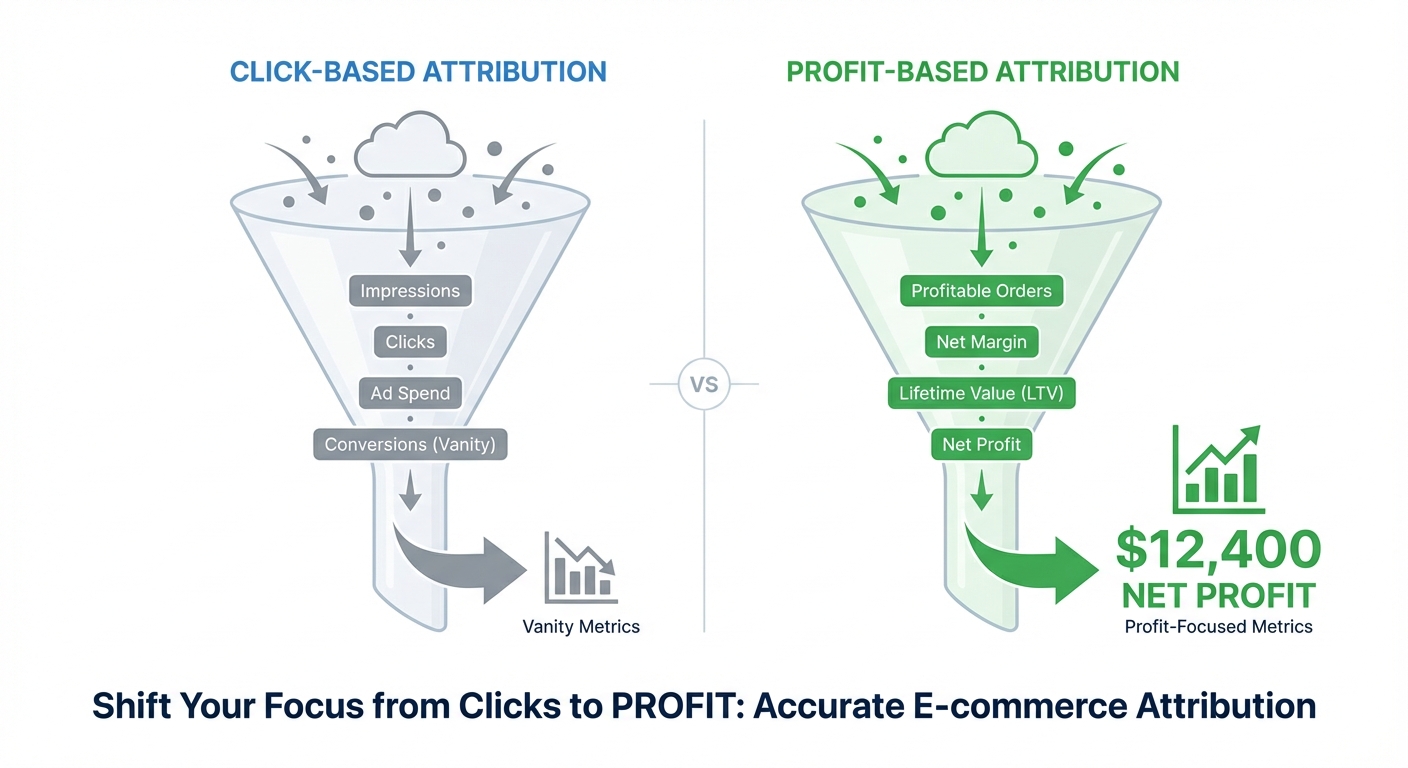
Attribution isn't about ego. It's not about which platform wants to look good in your dashboard. Attribution is about answering one question: If I hadn't spent money on this channel, would this customer have still bought from me?
That's it. That's the entire game.
For most small-to-mid-size Shopify stores, attribution gets tangled up with vanity metrics. You see Google Ads claiming it drove 500 conversions, Facebook claiming 300, and TikTok claiming 100. That's 900 conversions attributed. But you only had 600 orders last month.
So which channel actually worked? All of them are lying.
The reason this matters for profit: your profit margin depends on knowing which marketing channels are genuinely moving orders—not just which ones are good at taking credit.
If you're overstating Google's impact and understating organic traffic's role, you'll keep pumping money into Google while your organic game atrophies. If you think Facebook drove a sale that actually came from email, you'll keep increasing Facebook spend while email ROI goes unrecognized.
Bad attribution → bad budget allocation → lower profit.
The Main Attribution Models (And Why They're All Partially Wrong)
Before we talk about what actually works, let's walk through the models you'll hear about. Think of each as a way to slice the credit pie—but no model cuts it perfectly.
Last-Click Attribution
This is Shopify's default. When someone clicks your Facebook ad, then clicks a Google ad, then buys—Google gets 100% of the credit.
Why it exists: Simple. Easy to measure. Every platform can do it.
Why it's broken: It ignores everything that happened before the final click. Facebook might've warmed them up, built awareness, or even been the initial touch—but gets zero credit.
First-Click Attribution
Flip it. The first touch gets all the credit.
Why it exists: Shows you what awareness-building channels work.
Why it's broken: Ignores the middle touches that actually convince people to buy.
Linear Attribution
Split the credit equally across all touches. Four touches? Each gets 25%.
Why it exists: Feels fair. Acknowledges the whole journey.
Why it's broken: Equally fair isn't equally meaningful. The final touch matters more than random middle touch.
Data-Driven Attribution (Google's Version)
Google trains an ML model on your actual conversion data and says: "Based on patterns, here's how much each touchpoint probably influenced each sale."
Why it exists: Sophisticated. Can handle complex customer journeys.
Why it's broken: Black box. Google controls the data. Different platforms will give you different answers. You can't audit how credit was assigned.
| Attribution Model | Best For | Major Flaw |
|---|---|---|
| Last-Click | Performance channels, simplicity | Ignores awareness & nurturing |
| First-Click | Awareness campaigns, brand building | Ignores conversion assists |
| Linear | Balanced view, early development | Treats all touches equally |
| Data-Driven | Complex journeys | Vendor-dependent, non-transparent |
The Real Problem: Every Platform Over-Claims
Here's where it gets messy in practice.
Google Ads has a financial incentive to tell you "we drove that conversion." Same with Facebook, TikTok, Pinterest, and every other platform that charges you per click or impression.
They're not trying to lie—but they're all measuring attribution from their own perspective:
- Google sees: customer clicks Google ad → buys. Google-assisted conversion!
- Facebook sees: customer clicks Facebook ad → buys. Facebook conversion!
- Your email tool sees: customer clicks email link → buys. Email conversion!
The issue: you only had one customer. One order. One $200 sale.
But Google claims it. Facebook claims it. Email claims it. That's $200 × 3 in "attributed revenue" for a single order.
Most stores don't even realize this is happening because the numbers are buried in platform dashboards. You never see them all in one place, so you never realize how much the math doesn't add up.
The BeProfit Problem (And Others Like It)
Some tools make this worse. BeProfit, for instance, has become popular with Shopify stores for accounting and profit tracking.
Here's their flaw: they only count ad spend that has a UTM parameter in the order source. If someone clicked your Facebook ad but didn't have the UTM cookie, or came back directly (losing the UTM), BeProfit doesn't see that as "ad-attributed" spend.
So they hide that cost from your profit calculation. Result? Your profit margins look better than they actually are. You think you made $5,000 profit when you actually made $2,000 after accounting for unattributed ad spend.
This isn't malice. It's just how they chose to build their model. But it's dangerous for merchants because it creates a false sense of profitability.
Track this automatically
Shopimize shows your real profit per order, per product, per channel.
Try Shopimize free →The Practical Solution for Small-Mid Shopify Stores
Here's the truth: you don't need a sophisticated attribution model to run a profitable store.
You need two things:
- Total ad spend tracking (from your ads platform)
- Overall profit calculation (revenue minus all costs, including all ad spend)
That's it. That's your north star. If you spent $5,000 on ads and made $15,000 in revenue from new customers, and your product costs + shipping + other expenses = $7,000, you made $3,000 profit on those ads. Your ROAS was 3:1. Your true profit per dollar spent was $0.60.
Beyond that, UTMs are your second tool. They let you see which campaigns, channels, and content are driving traffic. They won't tell you the true attribution (nothing will), but they show you what's resonating.
Use UTMs + platform-reported spend to track the channels your customers used to find you. Use overall profit tracking to know if you're actually making money. The two together give you what you need to make smart budget decisions.
The Incrementality Question
There's one more concept worth understanding: incrementality.
Incrementality asks: Would this customer have bought anyway, without this ad?
Some customers will find you through organic search, word-of-mouth, or direct traffic. If you run an ad to someone who was already coming to your site, you're not creating an incremental sale—you're just stealing credit from organic.
Most merchants can't measure true incrementality without running holdout tests (showing ads to one group and not to a control group—expensive and complex).
But you can estimate it with common sense:
- Awareness campaigns to broad audiences? Lower incrementality (you're reaching people who might've found you anyway).
- Remarketing to past visitors? Higher incrementality (you're convincing people who already knew you existed).
- Bottom-of-funnel campaigns (search ads for branded terms)? Tricky—some of those searches happen because your ads reminded people you exist.
When you're building your marketing strategy, keep incrementality in mind. Don't just chase platforms with the highest conversion counts. Ask: Are these sales actually incremental to what I'd get anyway?
How Shopimize Handles Attribution (For Actual Profit)
At Shopimize, we believe attribution should serve profit, not stroke platform egos.
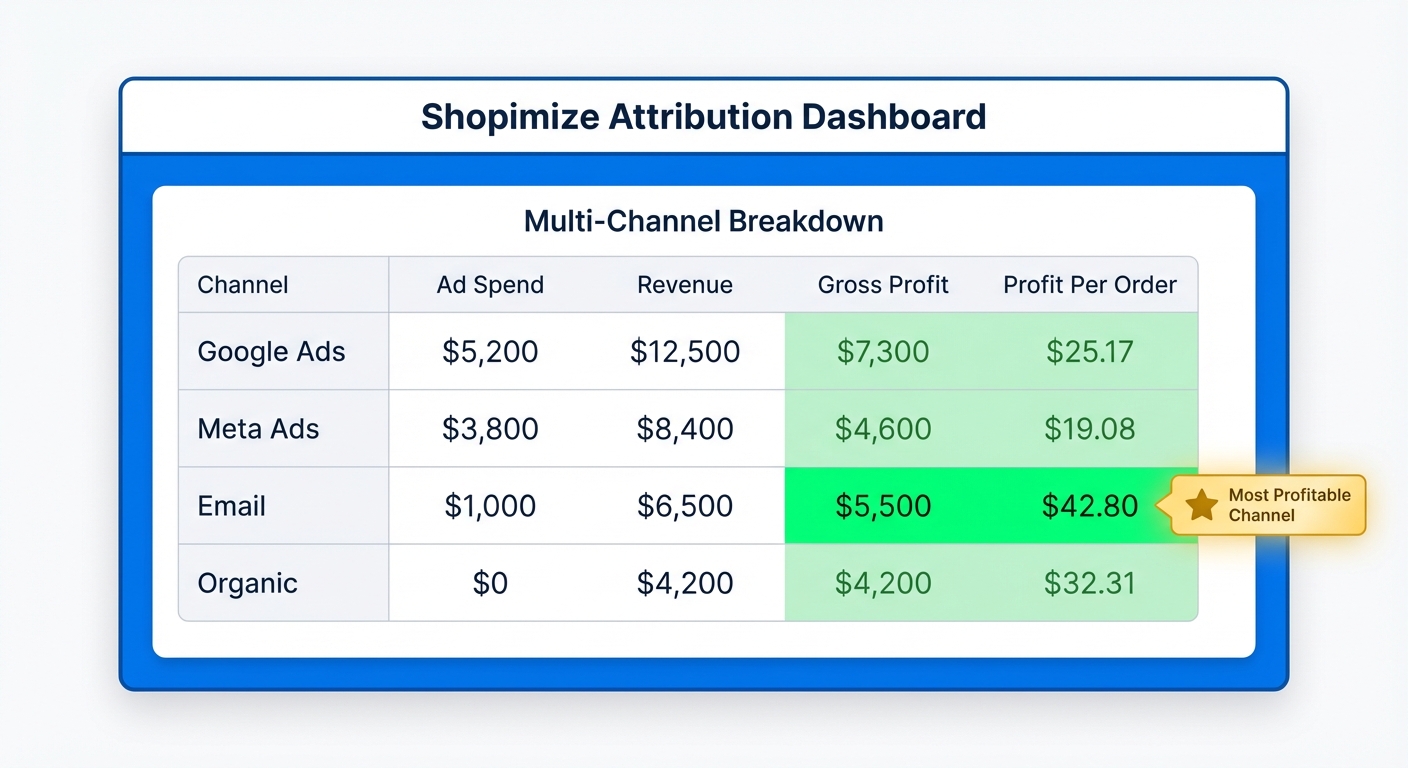
Here's our approach:
- Total platform-reported spend goes into your P&L as a cost. If you spent $500 on Google Ads, $300 on Facebook Ads, and $200 on email (if using a paid tool), that $1,000 comes out of profit. Full stop.
- UTM attribution is a drill-down tool, not your truth. You can see that $300 of your profit came from Google campaigns, $150 from Facebook, etc. But those numbers help you optimize—they don't define your actual profitability.
- Comparisons happen at the channel level. Google ads cost $2 per click and produced $4 in profit per click. Facebook ads cost $1.50 per click and produced $2.50 in profit per click. Which would you scale? Facebook. Simple.
This approach avoids the BeProfit trap. You're not hiding unattributed costs. You're not pretending conversion counts equal actual sales. You're just tracking what you spent, what you made, and doing the math.
Your Marketing Attribution Setup Checklist
Ready to implement this? Here's what you need to do:
Month 1: Foundation
- [ ] Audit all marketing spend from the past 3 months (ads, email tools, content, etc.)
- [ ] Set up consistent UTM parameters for all campaigns (format:
utm_source=facebook&utm_medium=paid&utm_campaign=summer_sale) - [ ] Document your UTM strategy so the whole team uses it the same way
- [ ] Connect Shopify to your accounting tool and verify revenue is tracking correctly
- [ ] Calculate your total new-customer revenue and total marketing spend for the period
Month 2: Channel Tracking
- [ ] Set up profit reports in Shopify that break down profit by traffic source (using UTM data)
- [ ] Create a simple spreadsheet: Channel | Spend | Orders | Revenue | COGS | Profit | Profit/Dollar
- [ ] Compare profit-per-dollar across your channels
- [ ] Identify your most profitable channel (not the one with most orders—the one with most profit)
- [ ] Identify your least profitable channel
Month 3: Optimization
- [ ] Increase spend on your most profitable channels
- [ ] Test if the least profitable channel can improve with better targeting, creatives, or offers
- [ ] Look for unattributed revenue (orders with no UTM) and consider why—lost cookies? Direct traffic? Organic?
- [ ] Set targets: "We want 3:1 ROAS across all paid channels" or "We want $1.50 profit per ad dollar"
- [ ] Review monthly and adjust
Ongoing: Red Flags to Watch
- [ ] If platform-reported conversions exceed your actual orders, investigate why (they're double-counting)
- [ ] If a channel shows great conversion rates but terrible profit per dollar, it's attracting cheap customers (or you have a unit economics problem)
- [ ] If organic traffic is growing faster than paid, that's a win—don't hide it
- [ ] If you're gaining new channels faster than you can track them, simplify
FAQ
Q: Should I use Google Analytics 4 for attribution?
GA4 is good for traffic insights, not profit insights. It'll show you how customers find you, but it won't tell you if you're actually making money. Use it alongside profit tracking, not instead of it.
Q: What if I can't set up UTMs across all my channels?
Start with your top 3 channels. Even partial data is better than none. As you grow, expand to new channels.
Q: Is multi-touch attribution worth the complexity?
For most small-mid stores, no. You get maybe 10% more insight for 5x more complexity. Stick with total spend + UTM tracking + profit calculation.
Q: How do I account for customers who buy multiple times?
That's a second problem (customer lifetime value). For now, focus on first-purchase attribution. Once you nail that, you can layer in repeat customers—but don't let it distract you from the basics.
Q: What if my profit margins are different by product?
Even better. Your attribution gets sharper. A customer who buys your high-margin product through Google Ads is more valuable than one who buys your low-margin product through Facebook. Start tracking profit by product if you can.
Q: Why does BeProfit make my margins look better than they actually are?
Because they only count UTM-attributed spend as marketing cost. Unattributed ad spend (which is real cost) gets hidden. Use a tool that counts all spend, or build your own in a spreadsheet.
The Bottom Line
Attribution will never be perfect. No model will ever tell you exactly how much credit each channel deserves.
But you don't need perfection. You need clarity.
Track your total ad spend. Track your total profit. Use UTMs to see which channels are performing. Compare profit per dollar across channels. Increase what works. Test what doesn't. Repeat.
That's not sexy. There's no AI-powered prediction. No black-box algorithm claiming to understand your customer's subconscious. Just math. Transparency. Honesty.
And that's what actually drives profitable orders.
Want to see which channels actually drive profitable orders — not just clicks? Try Shopimize free and connect every marketing dollar to real profit.
[IMAGE PLACEHOLDER: Dashboard screenshot showing profit breakdown by marketing channel with UTM attribution and total spend reconciled]