
Pricing Your Products for Real Profit, Not Just Revenue
You're doing good revenue. Maybe even great revenue. But somewhere between the orders coming in and the money hitting your account, profit's getting lost.
It's not an accident. It's a pricing problem.
Most pricing advice tells you to charge what the market will bear, undercut competitors by 5%, or use a blanket 50% markup. None of that works when you haven't accounted for the actual costs burying your business.
Here's what we see with sellers who fix their pricing: they often cut product counts, raise prices, and watch profit grow by 30–50% while volume stays steady. Same customers, same traffic, better margins.
This guide walks you through profit-first pricing—the only approach that matters when margins are tight.
[IMAGE PLACEHOLDER: Dashboard showing pricing vs profit comparison]
The Myth of the Markup
Let's start by killing the most common myth: the 50% markup is enough.
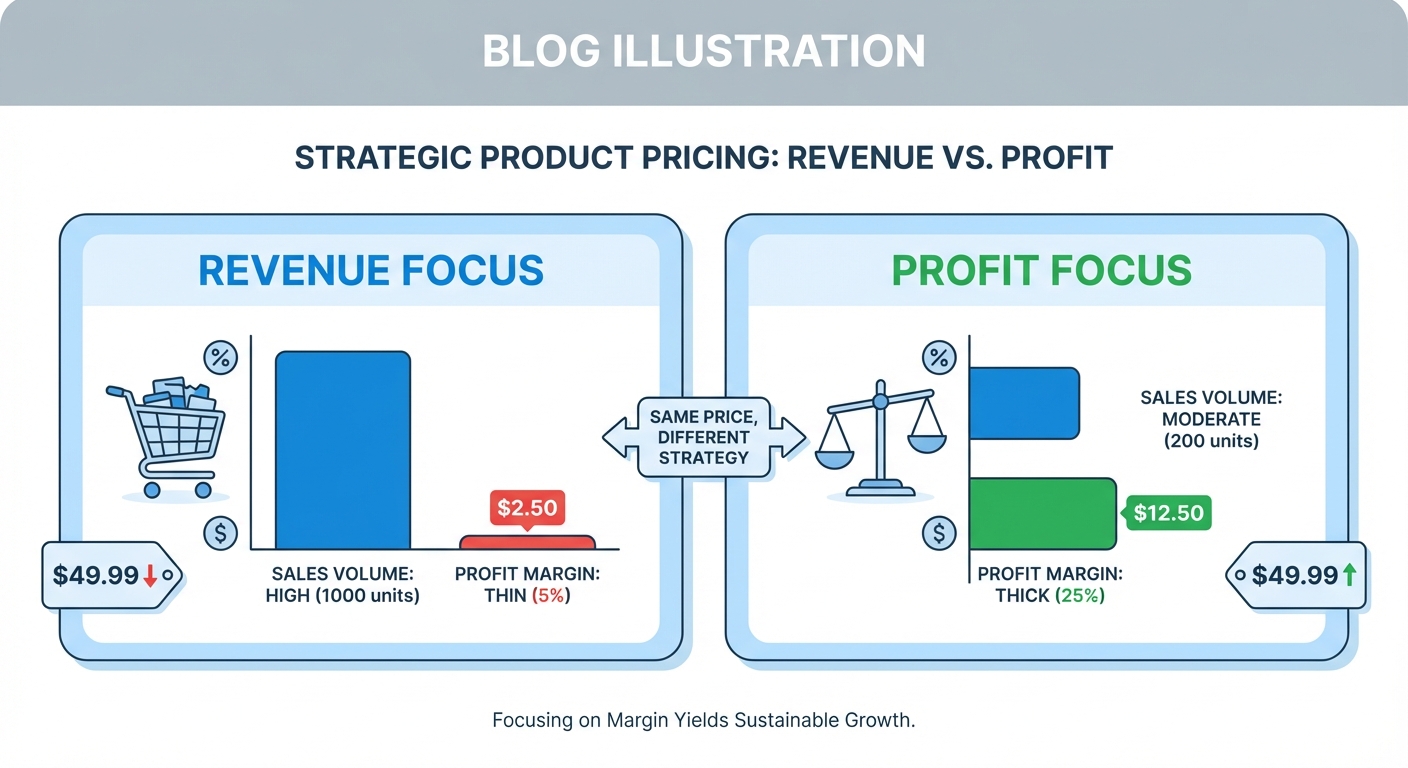
It isn't. Not even close.
Imagine you're selling a fitness tracker. Here's the breakdown:
- COGS: $15
- 50% markup: Price = $22.50
- Gross profit: $7.50
Now add your real costs:
- Payment processing (Stripe, PayPal): 2.9% + 30¢ = ~$0.95
- Shipping to customer: $3.50
- Packaging: $0.75
- Shopify platform fee: ~$0.30
- Returns (estimated): $1.12 (5% of revenue)
- Customer support (amortized): ~$0.50
Net profit: $7.50 – $0.95 – $3.50 – $0.75 – $0.30 – $1.12 – $0.50 = -$0.62
You're losing money on every sale.
The 50% markup only worked when people ran simpler operations: fewer channels, no paid ads, minimal packaging, customers who never returned anything. That world's gone.
Your pricing strategy has to account for every cost that touches your product. That's the only way to know your actual floor.
The Pricing Floor Formula
Start here. This is non-negotiable.
`
Minimum Price = COGS + Shipping + Processing Fee + Packaging +
Amortized Support + Returns Reserve + Target Ad CPA + Target Profit
`
Let's break it down:
- COGS (Cost of Goods Sold): Your landed cost per unit.
- Shipping: What you actually pay or credit to customers.
- Processing Fee: Payment processor fees + risk fees.
- Packaging: Boxes, tape, inserts, labels.
- Amortized Support: Divide total customer support hours by units sold per month.
- Returns Reserve: Percentage of sales you expect to lose to returns and refunds.
- Target Ad CPA: If you're paying to acquire the customer, include it here (optional; skip if organic-only).
- Target Profit: Your actual margin goal (e.g., 25% net).
This formula gives you a defensible floor. Below this price, you're subsidizing sales with your own cash. That math doesn't scale.
Three Products, Three Strategies
Let's see how this works in practice.
Product A: Low-Priced Consumable (Vitamin Gummies)
Unit costs:
- COGS: $2.20
- Shipping: $2.50
- Processing: $0.35
- Packaging: $0.40
- Support (amortized): $0.15
- Returns: $0.20
- Total floor: $6.80
- Target profit margin: 40% of COGS = $0.88
- Minimum viable price: $7.68
Market position: Competitors price at $14.99 for similar.
Strategy: Charge $14.99. Your net margin: ~57%. Volume matters here; you're scaling on loyalty and repeat orders, not one-off price arbitrage.
Product B: Mid-Range Item (Bluetooth Speaker)
Unit costs:
- COGS: $18.00
- Shipping: $4.00
- Processing: $1.23
- Packaging: $1.50
- Support (amortized): $0.60
- Returns: $2.00
- Paid ads (if applicable): $3.50
- Total floor: $31.33
- Target profit margin: 35% of COGS = $6.30
- Minimum viable price: $37.63
Market position: Competitors range from $39.99 to $59.99. Amazon's price: $42.99.
Strategy: Price at $49.99. Your net margin: 47%. You're profitable, competitive, and have room to run promotions without going underwater.
Product C: Premium Item (Weighted Blanket)
Unit costs:
- COGS: $35.00
- Shipping: $8.00
- Processing: $1.89
- Packaging: $3.00
- Support (amortized): $1.50
- Returns: $3.50
- Paid ads: $6.00
- Total floor: $58.89
- Target profit margin: 50% of COGS = $17.50
- Minimum viable price: $76.39
Market position: Competitors range from $99 to $199. Brand premium is real here.
Strategy: Price at $129.99. Your net margin: 45%. The high price point filters for quality-conscious buyers, reduces return rates, and attracts repeat customers who value durability over bargains.
In all three cases, you're profitable. You're competing on value, not race-to-the-bottom pricing.
Track this automatically
Shopimize shows your real profit per order, per product, per channel.
Try Shopimize free →Why $29.99 vs. $34.99 Doesn't Matter (When You're Unprofitable)
Pricing psychology is real. Studies show that prices ending in 9 convert better than round numbers. Charm pricing works.
When margins are healthy.
When you're operating at 8% net margin and burning cash, shaving a dollar to hit a psychological price point is just... math you can't afford.
Here's the honest truth: if your pricing model is broken, no psychological trick fixes it. You can't charm your way to profitability.
The reverse is also true: if your cost structure is sound and you're genuinely profitable, then you can play with charm pricing, tiered offers, and positioning. Then the psychology works because it's backed by real margin.
The framework: Build for profit first. Optimize perception second.
The Race to the Bottom Trap
Every marketplace has it. Amazon sellers undercutting each other. Etsy shops slashing prices to move inventory. Eventually, everyone's margin evaporates.
Here's what we see happen:
- Year 1: You set a price. It works. Decent margin.
- Year 2: A competitor undercuts you by $2. You match.
- Year 3: Three new competitors. You're all racing down. Margins compress to 12%.
- Year 4: You're shipping at a loss, funding returns out of savings, and burning out.
The escape route: stop competing on price. Compete on:
- Customer experience: Better packaging, faster shipping, responsive support.
- Brand: Build loyalty so customers choose you even if you're not cheapest.
- Product quality: Higher COGS item with lower return rate beats cheaper item with 20% returns.
- Positioning: "Premium" vs. "budget" are different markets with different customers.
The sellers we work with who never get trapped are the ones who own their pricing. They know their floor. They don't go below it. When a competitor undercuts, they don't panic—they double down on why they're different.
That confidence comes from data. From knowing exactly what profit you need, and pricing for it.
The Three-Layer Framework
Here's the mental model that separates thriving shops from struggling ones:
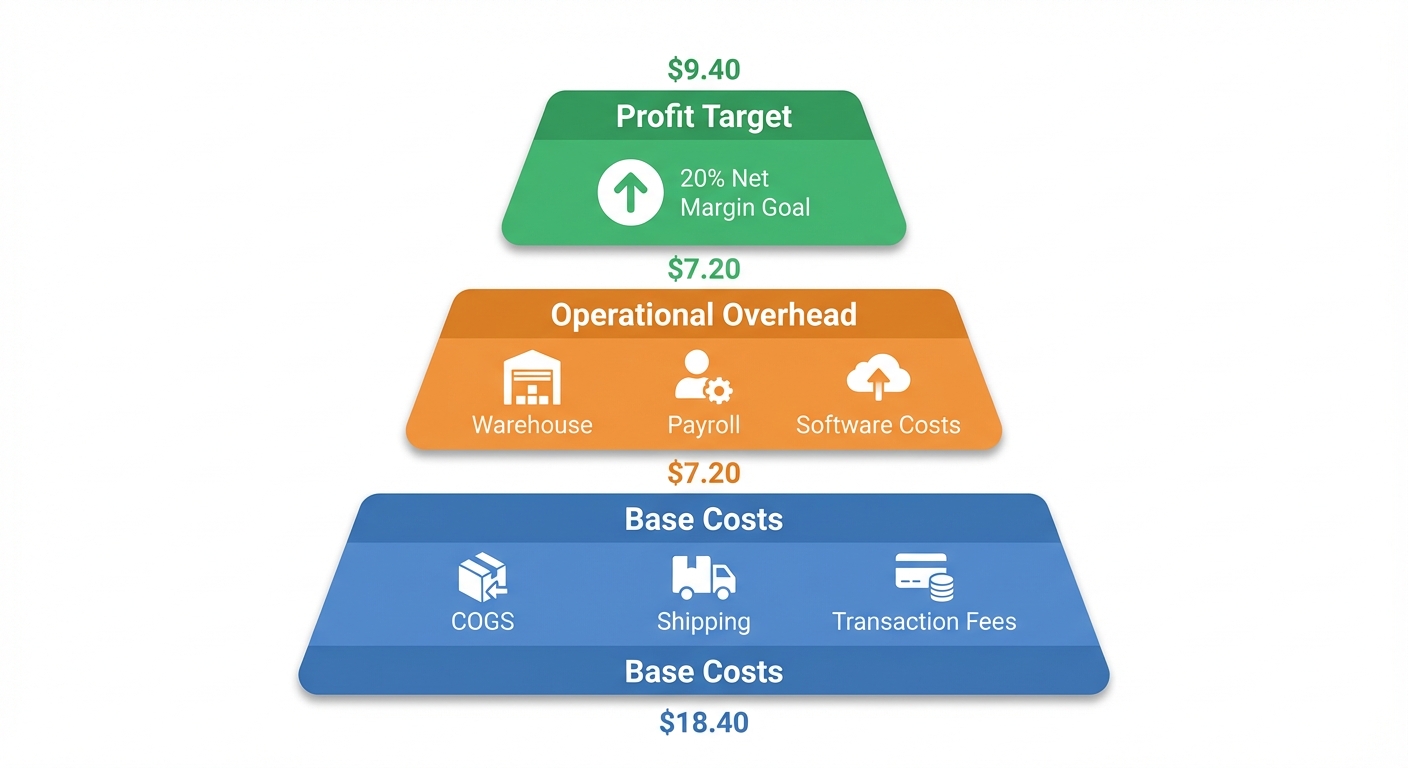
Layer 1: Cost-Plus Floor (Non-Negotiable)
This is the minimum. Use the formula we covered. No exceptions.
If you don't know your floor, you can't make intentional decisions. You're just guessing.
Layer 2: Competitive Positioning (Strategic)
Now look at what competitors charge. How do you position relative to them?
- At parity: Charge within 5% of the average. You're competing on service and brand.
- Premium: Charge 15–30% more. You need a clear value story (better materials, exclusivity, brand reputation).
- Value leader: Charge 15–25% less. Only if your costs truly support it and you're okay with volume-driven margins.
Most winners position at parity or premium. The math works better.
Layer 3: Perceived Value Ceiling (Reality Check)
What's the highest price customers will actually pay for this product?
It's different from your floor. It's different from competitive pricing. It's the maximum anchored by perceived value.
For a mass-market item, the ceiling might be 3–4x COGS. For a niche, premium item, it could be 10x COGS or higher.
If your competitive price sits below your ceiling, you have room. You can raise prices without demand collapse.
If you're already near the ceiling, raising prices means repositioning or adding genuine value.
Example: Fitness tracker with COGS of $15.
- Floor: $23
- Competitors: $39–$49
- Ceiling (perceived value): ~$65
You can confidently price at $45–$55. You're profitable, competitive, and below the ceiling. Good place to be.
Dynamic Pricing & Seasonality
Most Shopify stores miss this: you don't have to charge the same price year-round.
Smart pricing adapts to:
- Seasonality: Holiday demand goes up. Price up too (if supply allows).
- Inventory levels: Overstocked? Run a promotional price to clear. Low stock? Raise price or restrict availability.
- Cost changes: If COGS spikes (shipping, tariffs), adjust prices. Don't absorb margin hits.
- Customer segment: VIP/loyal customers might get bulk discounts. New visitors see standard pricing.
- Demand signals: If a product starts trending, price it accordingly. You have limited supply; make it count.
The key: these adjustments should be intentional and documented. You're not randomly tweaking prices to see what sticks. You're responding to actual business conditions.
[IMAGE PLACEHOLDER: Calendar showing seasonal pricing adjustments]
The Pricing Worksheet
Use this table to map your products' real costs and set defensible prices.
| Product | COGS | Shipping | Processing Fee | Packaging | Support (Amortized) | Returns Reserve | Ad CPA | Total Floor | Target Profit | Minimum Price | Competitor Price | Your Price | Margin % |
|---|---|---|---|---|---|---|---|---|---|---|---|---|---|
| Product A | $0.00 | $0.00 | $0.00 | $0.00 | $0.00 | $0.00 | $0.00 | $0.00 | $0.00 | $0.00 | $0.00 | $0.00 | 0% |
| Product B | $0.00 | $0.00 | $0.00 | $0.00 | $0.00 | $0.00 | $0.00 | $0.00 | $0.00 | $0.00 | $0.00 | $0.00 | 0% |
| Product C | $0.00 | $0.00 | $0.00 | $0.00 | $0.00 | $0.00 | $0.00 | $0.00 | $0.00 | $0.00 | $0.00 | $0.00 | 0% |
How to use it:
- Fill in actual costs for each product. Use real numbers from your suppliers, shipping calculations, and platform fees.
- Calculate Total Floor by adding all costs.
- Set your Target Profit based on business goals (15–50% depending on product type).
- Calculate Minimum Price.
- Research Competitor Price.
- Set Your Price based on positioning strategy.
- Calculate Margin % = (Your Price – Total Floor) / Your Price × 100.
If Margin % is below 20%, you're thin. If it's 35%+, you have room. 25–30% is healthy.
Common Pricing Mistakes
Mistake 1: Including Overhead in Per-Unit Pricing
Don't do this. Your rent, insurance, and salary are fixed costs. They don't change per unit. Bake them into your target profit margin as a percentage, not as a per-unit dollar amount.
Mistake 2: Forgetting Returns & Chargebacks
Returns are a real cost. Chargebacks happen. Reserve 2–5% of revenue depending on your category and customer base.
Mistake 3: Not Accounting for Paid Ads
If you're spending $3 to acquire a customer via Facebook ads, that's part of the cost of that sale. Include it in the pricing floor, not as a separate "marketing budget" line item.
Mistake 4: Pricing Below Cost to "Move Inventory"
This is the fastest way to go broke. If you have inventory you can't move at a profitable price, that's a product problem, not a pricing problem. Discount aggressively if you must, but never go below floor.
Mistake 5: Copying a Competitor's Price Without Understanding Their Costs
They might be bleeding money. Or they might have a different cost structure (bulk COGS, cheaper shipping, no ads). Don't assume their price is optimal for your business.
FAQ
Q: Should I change prices all at once or gradually?
Gradual is less risky. If you're raising prices 15–20%, do it in two 8% increases over 4–6 weeks. Watch for volume impacts. Most products see minimal volume loss at 8% increases when you're still competitive.
Q: What if my cost-plus floor is way higher than competitors?
You have a sourcing problem, not a pricing problem. Find cheaper suppliers, negotiate bulk discounts, or engineer the product to reduce COGS. Pricing can't fix broken cost structure.
Q: Can I use dynamic pricing without it feeling scammy?
Yes. Be transparent. "Price depends on inventory levels" or "Seasonal pricing" is honest. Hiding it—or making prices seem random—erodes trust.
Q: How often should I revisit pricing?
Quarterly at minimum. If COGS changes, change price immediately. If demand shifts, revisit within 30 days. Stale pricing is money left on the table.
Q: What about bundle pricing?
Same formula. Add the COGS and costs of all items in the bundle. Calculate the floor. Price the bundle 5–15% lower than items bought separately. Customers feel they're getting a deal. You maintain margin.
The Bottom Line
Profit-first pricing isn't complicated. It's just honest.
You calculate what it actually costs to deliver your product. You add the profit you need to survive and grow. You charge accordingly.
Everything else—psychological pricing, competitive positioning, seasonal adjustments—sits on top of that foundation.
Most businesses skip the foundation and wonder why they're broke.
You don't have to be one of them.
Want to see exactly how pricing changes affect your real profit? Try Shopimize free and model pricing scenarios with real data.