
How Much Does the Average Shopify Store Actually Make?
You've seen the headlines. "How I Built a Shopify Store Making $50K/Month in 90 Days." "Passive Income: Dropshipping on Autopilot." "Why I Quit My Job to Run Shopify Stores."
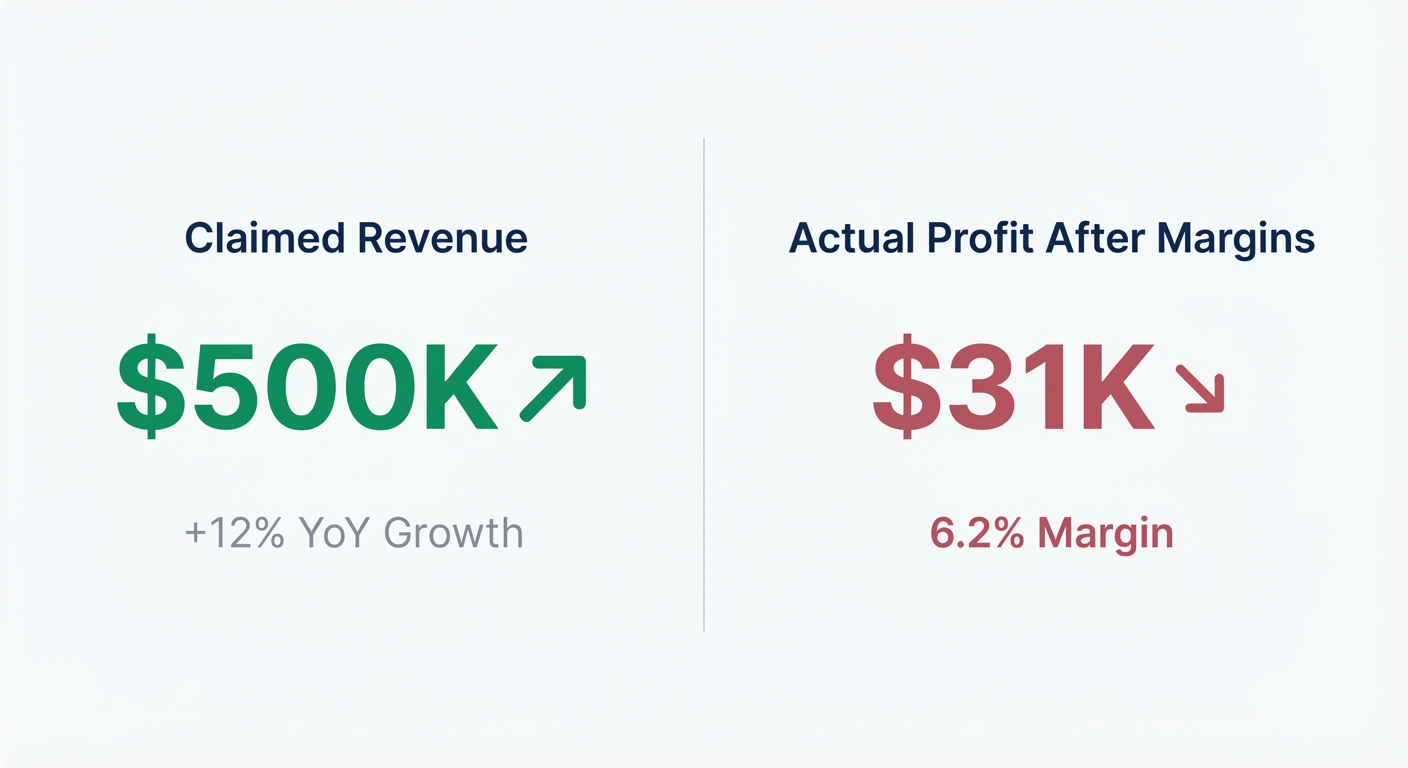
All of them have something in common: they don't tell you what actually sticks around for the owner after the bills are paid.
Let's be clear about what we're talking about here. Revenue—the total amount of money that flows through your store—is fun to brag about. But profit? That's what actually matters. That's rent, that's your paycheck, that's what separates a real business from an expensive hobby.
And yeah, there's a massive gap between the two.
The Clickbait vs. Reality Check
If you search "how much do Shopify stores make," you'll find a lot of survival bias. You'll read stories from the 2% who genuinely scaled. You won't hear from the other 98% who tried, spent money, and quietly shut down their store six months later.
Here's the thing: the stores making life-changing money do exist. But they're usually:
- Built on years of marketing and brand-building
- Run by someone who already knew their niche deeply
- Backed by either significant capital or a ton of sweat equity
- Lucky enough to catch a trend early (or just plain lucky)
Most stores don't work out that way. And that's not pessimism—it's just math.
The real question isn't "can a Shopify store make money?" It's "how much can your store realistically make, and what does the cost structure actually look like?" That's the question we'll answer here.
The Real Profit by Store Tier
Let's break this down by actual revenue size. These are realistic ranges based on common cost structures we see across the industry.
Hobby Stores: Under $5K/Month Revenue
These are the just-starting-out stores. The tests. The side hustles.
Typical monthly revenue: $500–$5,000
Typical monthly profit: $200–$800
Profit margin: 15–25% of revenue
At this stage, you're running everything yourself. Your biggest costs are:
- Shopify subscription: $29–$99
- Payment processing fees: 2.9% + $0.30 per transaction
- Shipping & fulfillment: Highly variable, but typically 20–35% of the order value
- Apps & tools: $50–$150
- Ads (if you're running any): $200–$500
At $1,000 in monthly revenue, you might keep $200–$300. At $5,000, you might keep $800–$1,200.
Here's the hard part: this is effort, not passive income. You're answering emails, packing boxes, managing inventory, and obsessing over your conversion rate. The time cost is brutal—and if you paid yourself an hourly wage, it'd evaporate your profit entirely.
Growing Stores: $5K–$25K/Month Revenue
Now you're getting real traction. You've found a product or niche that works. You're reinvesting in ads, and they're paying off.
Typical monthly revenue: $5,000–$25,000
Typical monthly profit: $1,500–$5,000
Profit margin: 15–25% of revenue
Your costs are more structured now:
- Shopify subscription: $99–$299 (depending on plan)
- Payment processing: 2.9% + $0.30 per transaction
- Shipping & fulfillment: 20–30% of revenue (you might negotiate bulk rates now)
- Ads (Facebook, Google, TikTok): 20–40% of revenue
- Tools & apps: $200–$500
- Your time: Still substantial, though you might hire occasional help
At $10,000/month revenue, you're probably pocketing $2,000–$3,000.
At $25,000/month, you might hit $4,000–$6,000.
The trap here is scaling ads. Many store owners get excited about growth and dump 50% of revenue back into ads, thinking "I'm investing in scale." Sometimes that works. Often, you're just feeding the ad algorithm and moving further from profitability. This is where most stores plateau or die.
Established Stores: $25K–$100K/Month Revenue
You've proven the model. You have repeat customers. Your unit economics make sense.
Typical monthly revenue: $25,000–$100,000
Typical monthly profit: $5,000–$20,000
Profit margin: 20–30% of revenue
Now you can afford better:
- Shopify subscription: $299–$2,300 (Shopify Plus if you're at the high end)
- Payment processing: 2.5–2.9% (negotiated rates)
- Shipping & fulfillment: 18–28% (economies of scale, negotiated carrier rates)
- Ads: 15–30% of revenue (more efficient targeting, better creatives)
- Tools & team: $500–$2,000 (you've likely hired your first person or two)
- Customer acquisition cost: Optimized, tracked, predictable
At $50,000/month, you're probably keeping $10,000–$15,000.
At $100,000/month, you might hit $20,000–$30,000.
Profitability gets better because you're more efficient. Your ad spend per dollar of revenue drops. Your fulfillment costs drop. Your time per order falls as you systematize.
But here's the reality: even at $100K/month revenue, you're probably working 40+ hours a week. The profit per hour is good, but it's not "set it and forget it."
Scale: $100K+/Month Revenue
This is where Shopify stories often live. This is real business.
Typical monthly revenue: $100,000+
Typical monthly profit: $15,000–$40,000+
Profit margin: 25–40%+ of revenue
At this level:
- Shopify subscription: $2,300–$10,000+ (Plus plan, custom)
- Payment processing: 2.2–2.6% (enterprise rates)
- Shipping & fulfillment: 15–25% (negotiated freight, potentially your own logistics)
- Ads: 10–20% of revenue (highly optimized, strong ROAS)
- Team: $3,000–$10,000+ (customer service, operations, marketing)
- Technology & infrastructure: $1,000–$5,000
At $500,000/month, you might keep $100,000–$150,000.
The profit margins compress less here because you've optimized almost everything. Your unit economics are clean. You know your numbers cold. You can afford to be strategic instead of reactive.
But here's the catch: most stores don't get here. The jump from $25K to $100K is steep. The jump from $100K to sustainable, hands-off profit is even steeper.
[IMAGE PLACEHOLDER: Bar chart showing typical profit ranges by tier, with revenue on x-axis and profit margin % on y-axis]
Revenue vs. Take-Home: Real Examples
Let's make this concrete with a few scenarios.
Scenario 1: The Hobby Store
You're selling handmade candles on Shopify. You're marketing on Instagram and getting traffic from friends and word-of-mouth.
- Monthly revenue: $2,500
- Shopify & apps: $150
- Shipping supplies & postage: $700 (28% of revenue)
- Payment processing: $80
- Instagram ads: $300
- Leftover: $1,170
But wait. You spend 15 hours a week on this. That's 60 hours a month. You're making $19.50/hour. After taxes, it's closer to $12–$15/hour. That's rough.
Scenario 2: The Growing Store
You're selling eco-friendly skincare. You've hired a fulfillment center. Your ads are working.
- Monthly revenue: $18,000
- Shopify (Professional): $299
- Fulfillment center: $4,000 (22% of revenue)
- Shipping carrier fees: $900 (5%)
- Payment processing: $530
- Ads (Facebook & Google): $5,400 (30%)
- Tools & subscriptions: $300
- Leftover: $6,571
You're working 30 hours a week on operations and marketing. That's $437/hour. Much better. But you're also reinvesting heavily to grow, so you might only take home $3,000–$4,000.
Scenario 3: The Established Store
You're selling apparel in a specific niche. You have systems. You know your repeat customer rate.
- Monthly revenue: $65,000
- Shopify (Advanced): $1,000
- Fulfillment: $14,000 (22%)
- Shipping: $3,000 (5%)
- Payment processing: $1,885
- Ads: $13,000 (20%)
- Team (part-time ops): $2,500
- Tools: $800
- Leftover: $28,815
You're working 25 hours a week on strategy and growth. That's $1,153/hour. Sustainable. Real business.
Want to see your real numbers?
Try our free profit calculator — plug in your numbers and see your real net margin in 30 seconds.
Try the free calculator →What Affects Profit at Each Stage?
The profit levers change as you grow.
At small scale ($1K–$10K/month): Your time is the limiting factor. You're doing customer service, packing boxes, and marketing yourself. Profitability improves most if you either automate fulfillment (hire a 3PL) or cut inefficient marketing spend. The biggest win is efficiency, not volume.
At mid-scale ($10K–$50K/month): Ad efficiency becomes critical. Your profit margin depends heavily on your customer acquisition cost relative to customer lifetime value. A 0.5% improvement in ROAS can mean thousands in profit. This is also where you need to invest in team.
At scale ($50K+/month): Operational efficiency and customer lifetime value dominate. You're optimizing repeat purchase rate, average order value, and shipping costs. You might have margins that are 5–10 points better just because you've negotiated better rates and reduced churn.
Profit by Niche
Your industry matters a lot. Here's a rough breakdown of typical margins by category:
| Niche | Typical Revenue | Typical Margin | Notes |
|---|---|---|---|
| Beauty & Skincare | $5K–$50K | 25–40% | Higher margins, repeat purchases, but ad costs are high |
| Apparel | $10K–$100K | 30–50% | Strong margins, but seasonal, high returns |
| Electronics | $20K–$500K+ | 15–25% | Lower margins, faster inventory turnover, complex support |
| Home Goods | $8K–$75K | 35–55% | Good margins, longer buyer journey |
| Supplements | $10K–$200K+ | 40–60% | High margins, repeat business, regulatory risk |
| Dropshipping | $5K–$30K | 5–15% | Low margins, thin profit, competitive |
Notice that dropshipping (where you don't hold inventory) has the lowest margins. That's why so many dropshipping stores fail—you need volume to make real money. A 10% margin on $10K revenue is $1,000. On $50K, it's $5,000. You're constantly chasing bigger numbers just to get the same profit.
Beauty, apparel, and supplements have better unit economics because of repeat purchases and higher margins.
[IMAGE PLACEHOLDER: Stacked bar chart showing typical revenue breakdown (COGS, shipping, ads, operations, profit) for different niches]
The Survivorship Bias Problem
Here's what you don't see: the story of the store that did $8,000/month for six months, the owner got burned out, and they shut it down. Or the store that hit $30K/month but had zero profit because of unsustainable ad spend. Or the beautifully designed store that made $500/month and the owner is underwater on their initial investment.
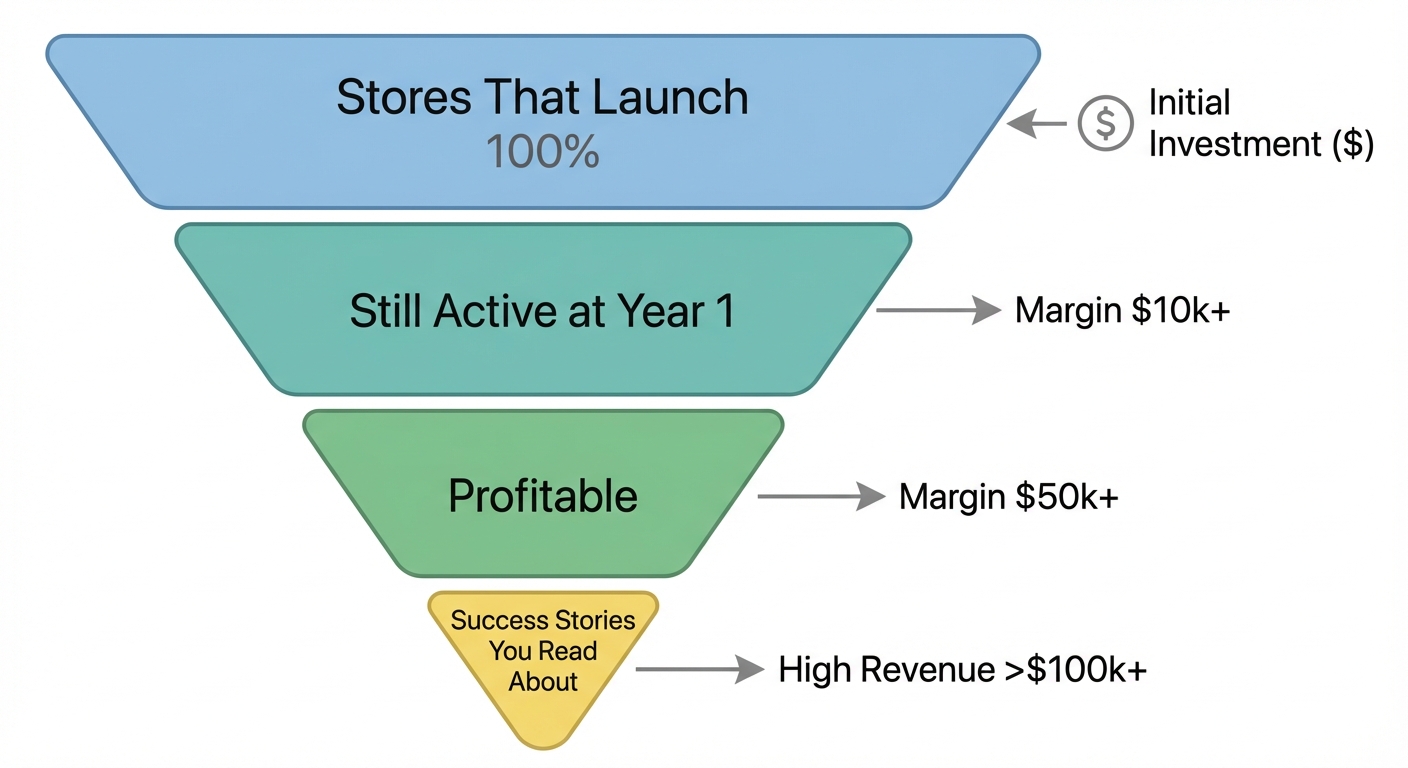
These are the majority of stores, but they don't write blog posts about it.
The stores you hear about—the $100K/month ones, the "I quit my job" stories—are real. But they're also the exception. It's like hearing success stories from a casino and forgetting about everyone who lost money.
This doesn't mean you can't be successful. It means you should plan for the long, unglamorous slog of getting there. Most successful stores take 2–3 years to hit $25K/month revenue sustainably.
Benchmarks: Is Your Store Healthy?
Here's a simple way to check if your store is on track:
If you're doing $5K–$10K/month: You should be keeping at least 10–15% of revenue as profit (after owner's time). If not, your COGS or ad spend is out of whack.
If you're doing $10K–$25K/month: Aim for 15–20% profit margin. Below that, your customer acquisition cost is likely too high.
If you're doing $25K–$50K/month: You should be at 20–25% profit margin. If you're below that, you either haven't negotiated supplier rates yet, or you're overinvesting in ads.
If you're doing $50K+/month: You should be hitting 25–30% or higher. If not, something's broken (or you're intentionally investing back for growth).
These aren't guarantees—your niche matters. But they're reasonable benchmarks.
What Owners Don't Talk About
- Taxes. You owe 15–25% of profit to federal and state taxes (plus self-employment tax if you're sole proprietor). Your "$15,000 monthly profit" is really $10,000–$12,000 in your pocket.
- Seasonality. Q4 is huge. Q1 is brutal. Plan for it.
- The time sink. Even at $50K/month, most owners work 30–40 hours a week. It's not passive.
- Returns and refunds. You'll lose 5–30% of gross revenue to returns, depending on your niche. (Apparel is brutal; supplements are usually lower.)
- Payment processing chargebacks. These are rare but they happen, and they hurt.
- Inventory risk. If you hold stock, bad inventory decisions kill margins.
- Platform risk. Shopify could change terms. Your ad account could get shut down. Your supplier could vanish. These happen.
The Bottom Line
The average Shopify store probably makes between $1,000–$5,000/month in profit. But "average" is useless when the range goes from -$500 (losing money) to +$50,000 (genuinely thriving).
What matters is your store, your niche, and your numbers.
If you're just starting out, expect low profit for 6–12 months as you figure out what works. If you're in the $5K–$25K range, focus obsessively on unit economics—how much does each customer actually cost you, and how much do they spend? If you're at $25K+ and not hitting 20%+ profit margin, something needs to change.
The stores that win aren't the ones that chase the next trend. They're the ones that understand their numbers, optimize relentlessly, and stay in the game long enough for compound growth to kick in.
FAQ
Q: Can a Shopify store really make $10K/month?
Yes. But it usually takes 18–36 months, significant marketing investment, and a founder who's either obsessed or has prior business experience. "Can" and "will" are very different words.
Q: Is dropshipping profitable?
It can be, but the margins are thin (5–15%). You need 5–10x the volume to match someone selling physical products with 30–40% margins. Most people underestimate how much capital and patience this requires.
Q: What's the biggest factor that kills stores?
Unsustainable customer acquisition cost. Owners spend $5 to acquire a customer who spends $6. It feels like profit, but it's actually a slow-motion bankruptcy.
Q: Do I need venture capital to build a real Shopify store?
No. Most successful stores start with less than $5K. But you will need patience and willingness to learn the hard way. Paid education and tools help speed this up.
Q: How do I know if my profit margin is good?
Compare to your niche benchmarks (see the table above). Then compare to your own history. Trends matter more than absolutes. If your margin is dropping month-over-month, investigate why.
Q: What's the easiest way to improve profit?
For small stores: cut unprofitable ad spend and focus on organic growth and repeat customers.
For growing stores: negotiate better COGS and 3PL rates; optimize ad targeting.
For established stores: increase customer lifetime value through email and loyalty programs.
Ready to Understand Your Own Numbers?
Knowing what the "average" store makes is useful context. But benchmarking against your own potential is what actually matters.
Want to see where your store sits? Try Shopimize free and compare your real profit against benchmarks for your niche. You'll see your profit margins, your biggest cost drains, and exactly where to focus to improve.
Because the stores that make real money aren't the ones that get lucky. They're the ones that know their numbers.